
For more than a decade, digital experiences have been organized around apps. Users open an application, navigate through menus, find the right feature, enter information, and complete a task. This model has shaped everything from banking and shopping to healthcare, productivity, and entertainment.
But the way people interact with technology is beginning to change. AI assistants can already complete tasks through natural-language requests. Voice interfaces are becoming more capable, operating systems are integrating AI directly into the user experience, and intelligent agents can increasingly work across multiple services without requiring users to open each application individually.
This raises an important question: if users can simply tell technology what they want, will they still need apps at all?
The answer is unlikely to be that applications disappear completely. What may disappear is the assumption that opening and navigating an app must always be the primary way to access digital services.
For companies planning new digital products, understanding how interfaces are changing can influence decisions being made today about architecture, APIs, user experience, and product strategy.
- Apps are unlikely to disappear completely, but their role may change. Many services could become accessible without opening a traditional application.
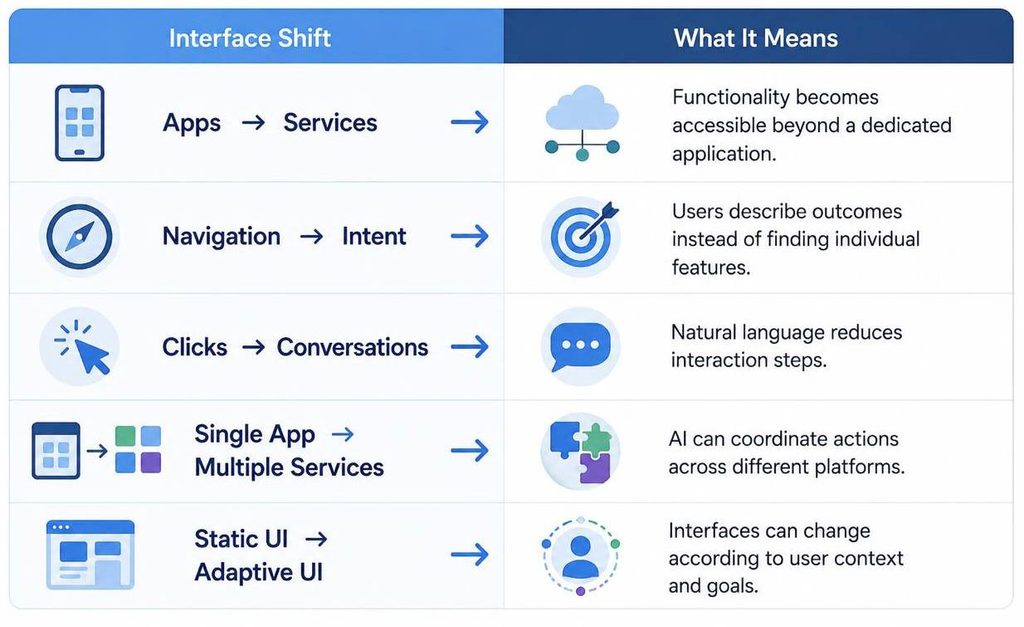
- Interfaces are moving from navigation toward intent. Users increasingly expect to describe what they want rather than learn where every function is located.
- Visual interfaces will remain important. Complex, creative, analytical, and highly visual tasks still benefit from screens and dedicated applications.
Why the Traditional App Model Is Changing
Traditional applications place much of the interaction burden on the user. To accomplish something, people need to know which application to open, understand its interface, locate the correct feature, provide the necessary information, and move through a predefined sequence of screens.
This made sense when software needed explicit instructions at every step. But AI introduces another possibility: software can increasingly interpret the user’s intention. Instead of opening a travel app, selecting dates, entering a destination, choosing filters, and comparing results manually, a user could simply ask for suitable options within a particular budget and schedule.
Instead of navigating through several financial dashboards, a manager could ask why operating costs increased last month and receive an explanation based on connected business data.
The difference is significant. Users move from operating software to expressing intent. This does not eliminate the underlying application. The booking engine, payment infrastructure, database, recommendation system, and business logic still need to exist. What changes is the layer through which the user reaches them.
From Graphical Interfaces to Intent-Based Interfaces
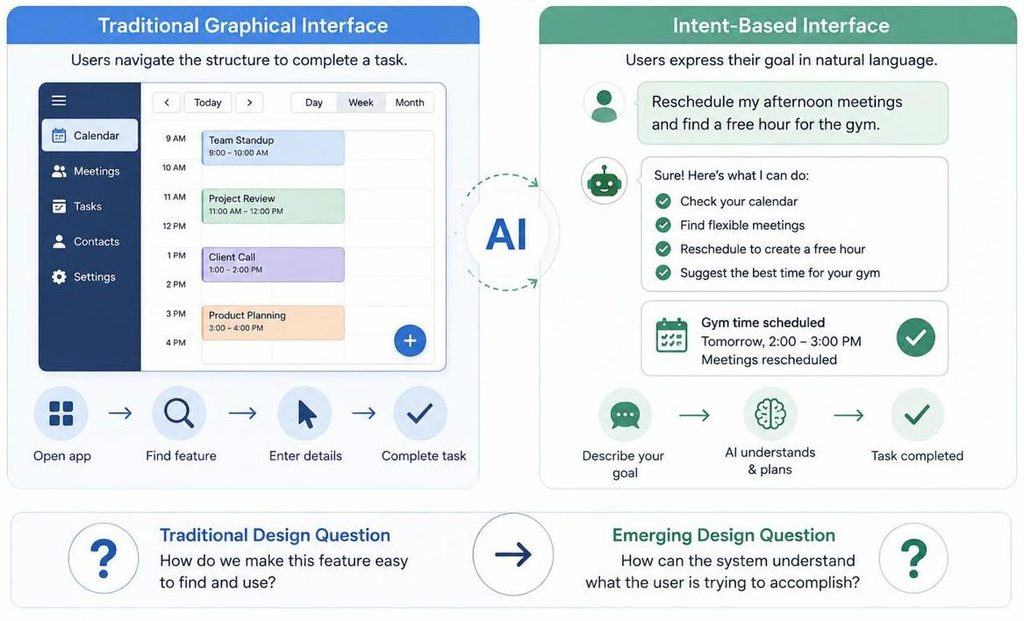
Graphical user interfaces transformed computing by replacing commands with visual elements such as buttons, menus, icons, and windows. Mobile applications extended this model to touchscreens. AI is introducing another interaction model: the intent-based interface.
Instead of requiring users to understand how software is structured, the system attempts to understand what outcome the user wants.
A request such as “reschedule my afternoon meetings and find a free hour for the gym” contains an objective rather than a sequence of instructions. An intelligent system can potentially determine which calendars need to be checked, which meetings can be moved, what constraints apply, and which actions are required. This reduces the number of interactions between intention and outcome.
For product design, that represents an important change. The traditional question has been: How do we make this feature easy to find and use? The emerging question is: How can the system understand what the user is trying to accomplish?
AI Assistants as the New Interface Layer
AI assistants could increasingly sit between users and individual applications.
Today, a person may interact separately with a calendar, email client, CRM, project management platform, travel service, banking application, and dozens of other digital products.
Each has its own interface and interaction model. An intelligent assistant could provide a common layer across those services. A user might ask it to prepare for tomorrow’s meetings, summarize relevant emails, check project deadlines, and identify scheduling conflicts. The assistant would interact with several underlying systems while presenting the result through one interface.
In this model, applications do not necessarily disappear. They become services behind the interface. This could fundamentally change product competition. Businesses may no longer compete only for screen time or app engagement. They may also compete to become the service selected by AI systems when users request a particular outcome.
What Happens to Apps?
The future is unlikely to involve a sudden transition from apps to no apps. Different categories of software require different levels of direct interaction.
A messaging service may increasingly be accessed through an AI assistant for tasks such as finding information or summarizing conversations, while users still open the application when they want to participate directly. A banking assistant might handle simple transfers or explain spending patterns, while the full application remains important for detailed financial management.
Design tools, gaming platforms, video applications, development environments, analytics dashboards, and other highly visual products are even less likely to lose their graphical interfaces. What may decline is the need to open an app for every small digital task. The application becomes one possible interface rather than the only interface.
From Navigation to Intent
The transition is already visible in how consumers and businesses are adopting AI-driven interaction. Generative AI has rapidly introduced millions of users to conversational interfaces, while major technology platforms are embedding AI assistants directly into operating systems, productivity suites, search experiences, browsers, and devices. At the same time, voice recognition, multimodal AI, and agentic systems are improving the ability of software to understand requests involving text, images, audio, and contextual information.For businesses, the important trend is not simply the number of people using AI. It is the growing expectation that software should require less navigation and fewer manual steps.
Why APIs Become Even More Important
If AI assistants are going to interact with digital services on behalf of users, applications need to expose their functionality in ways that machines can understand, access, and use reliably. This makes APIs increasingly important not only as a technical integration layer, but as a core part of product strategy.
A beautifully designed application may provide an excellent experience for a human user, but an AI agent does not interact with software in the same way. If important functionality exists only behind visual buttons, menus, and screens, it becomes much harder for another system to access that functionality safely and consistently.
APIs solve this problem by providing structured access to business capabilities. Instead of trying to imitate human interaction with an interface, an AI assistant can communicate directly with the underlying service. It can request information, perform an approved action, receive a predictable response, and use that result as part of a larger workflow.
Consider a travel platform. A user might ask an AI assistant to find a suitable flight, compare available options, book the selected itinerary, and add it to a calendar. The user may never need to manually navigate the airline or booking application, but the services behind that experience still need to search availability, return pricing, process reservations, and confirm transactions. APIs make those capabilities accessible beyond the traditional application interface.
Will Screens and Visual Interfaces Still Matter?
Yes. Natural language is powerful, but it is not the ideal interface for every task. Users do not want to describe every design change verbally when editing an image. Analysts often need to explore charts visually rather than receive a long spoken explanation. Shoppers may want to browse products instead of describing exactly what they want. Developers need to inspect code, and creative professionals benefit from direct manipulation of visual objects.
There is also a difference between asking technology to perform a task and exploring possibilities. When users know exactly what they want, conversational interfaces can be extremely efficient. When they are comparing, discovering, creating, or investigating, visual interfaces often provide more context and control.
This is why the future is more likely to be multimodal than purely conversational. Users may begin with a voice or text request, receive a visual interface when comparison is useful, manipulate the result directly, and then ask AI to complete the next step.
The Challenge of Trust and Control
Removing interface steps creates convenience, but those steps sometimes provide important opportunities for verification.
If an AI assistant recommends a restaurant, the risk is relatively low. If it transfers money, purchases an expensive flight, modifies a production environment, or shares sensitive company information, users need greater control.
This creates a major design challenge for agentic interfaces: how much autonomy should the system have? Future interfaces will need mechanisms for confirmation, permissions, transparency, reversibility, and clear communication about what an AI system is about to do. Users may not need to navigate ten screens to complete a task, but they still need confidence that the system understood the request correctly.
The best interfaces may therefore remove unnecessary interaction while preserving meaningful control.
From App-First to Interface-Agnostic Products
For businesses, one of the biggest strategic changes may be moving away from thinking exclusively in terms of applications. Traditionally, companies often start with a channel: build a mobile app, build a website, or create a desktop product.
An interface-agnostic approach starts with capabilities. What can the service do? What data does it need? Which actions can users perform? How can those capabilities be securely exposed to different interfaces? Once these capabilities are separated from the presentation layer, the same product can support a mobile application, web interface, voice assistant, AI agent, embedded experience, or another interaction model. This makes products more adaptable to future changes in user behavior.
Companies do not need to predict exactly which interface will dominate. They need architectures capable of supporting whichever interfaces users choose.
The shift beyond traditional applications introduces several challenges. Identity and authentication become more complex when agents act on behalf of users across multiple services. Businesses need to determine which actions AI systems are allowed to perform and how permissions should be managed.
Discovery may also change. If users increasingly ask assistants to choose services for them, businesses will need to understand how their products become discoverable and selectable by AI systems.
Brand relationships could change as well. A user may receive a service from a company without ever opening its application or interacting directly with its traditional interface. Finally, companies need to avoid replacing simple interfaces with unnecessary AI. A button can still be better than a conversation when the required action is obvious. The goal should not be to eliminate interfaces. It should be to reduce friction between user intent and the desired outcome.
Ready to build future-ready products with Ficus Technologies.
Contact usConclusion
Apps are not about to disappear overnight. But the role they play in digital experiences is beginning to change.
AI assistants, agents, voice interfaces, and multimodal systems are creating new ways for users to interact with technology without navigating every application directly. As these systems improve, more digital services may move behind an intelligent interaction layer. Visual interfaces will remain essential for many tasks, particularly those requiring exploration, creativity, comparison, or precise control. But routine actions may increasingly happen without users thinking about which application is responsible for completing them.
The future may therefore be less about apps versus AI and more about separating services from interfaces. The companies best prepared for this shift will be those that build flexible architectures, accessible APIs, strong permission models, and digital services that can work across multiple interaction layers. The app may not disappear. But it may no longer be where the experience begins.
Why Ficus Technologies?
At Ficus Technologies, we help businesses build flexible digital products designed for changing user behaviors and emerging technologies. From mobile and web applications to API-first platforms, AI integration, cloud architecture, and intelligent automation, we create systems that can evolve as interfaces change.
Build digital products ready for what comes after the app — with Ficus Technologies.
Probably not. Apps will remain important, but users may increasingly access their functionality through AI assistants, voice interfaces, and other interaction layers.
An intent-based interface allows users to describe the outcome they want instead of manually navigating through features and screens.
AI can make interfaces more conversational, adaptive, and proactive while reducing the number of manual steps required to complete tasks.
APIs allow applications, AI assistants, and other systems to securely access functionality without depending on a traditional graphical interface.
There may be no single replacement. The future is likely to combine apps, AI assistants, agents, voice interfaces, and multimodal experiences.





 Success...!