Modern technology stacks are more powerful than ever. Companies can combine cloud infrastructure, SaaS platforms, APIs, microservices, containers, databases, analytics tools, AI services, security platforms, and open-source technologies to build sophisticated digital products faster than previous generations of engineering teams could.But every new capability introduces another dependency.
What begins as a flexible technology stack can gradually become a complex ecosystem where hundreds of services exchange data, applications depend on multiple platforms, teams use different tools, and a failure in one component creates unexpected problems somewhere else.
The challenge is not simply that companies use more technology. It is that the relationships between technologies are becoming harder to understand and manage. For modern organizations, system complexity is becoming an operational issue that affects development speed, reliability, security, cloud costs, and the ability to change products safely.
- Modern tech stacks become complex through accumulation. New tools, services, integrations, and platforms are continuously added while older components often remain.
- Dependencies create more complexity than individual technologies. The difficult part is understanding how hundreds of components interact.
- Distributed architectures increase operational responsibility. Microservices and cloud platforms create flexibility but also introduce networking, observability, deployment, and data challenges.
How Modern Tech Stacks Became So Complex
Technology stacks rarely become complicated because an organization deliberately designs them that way.
Complexity usually grows incrementally. A company introduces a new cloud service because it solves an immediate infrastructure problem. Another team adopts a different database because it fits a particular workload. A third adds an observability platform. New APIs connect external services. Security tools are introduced. Analytics pipelines expand. AI capabilities require additional models, vector databases, data pipelines, and monitoring. Each decision can make sense individually. The problem appears when hundreds of reasonable decisions accumulate without considering the system as a whole. Legacy technology rarely disappears at the same speed new technology is introduced. Older applications continue supporting important business processes while new services are built around them. Temporary integrations become permanent. Experimental tools move into production. Eventually, organizations are no longer managing a technology stack in the traditional sense. They are managing a technology ecosystem.
Complexity Is Mostly About Connections
Counting technologies alone does not reveal how difficult a system is to manage.
A company could operate 100 relatively independent services with clear boundaries and predictable behavior. Another could operate 20 systems that are tightly connected and extremely difficult to change. The difference is dependency. Every integration creates a relationship that needs to remain compatible. APIs change. Schemas evolve. Authentication mechanisms are updated. Services become unavailable. Data formats change. Network conditions introduce failures. As dependencies increase, engineers need to understand not only individual components but also how changes propagate across the environment. A simple update to one service can unexpectedly affect several downstream applications. A database schema change can break analytics pipelines. A third-party API update can interrupt a customer workflow.This is why system complexity grows faster than the number of technologies alone suggests. Every new component can create multiple new relationships with the systems already around it.
When Technology Scale Becomes Complexity
Modern technology environments can grow far beyond what any individual team can easily understand. A single organization may operate hundreds of SaaS applications, cloud services, APIs, repositories, databases, containers, and internal tools at the same time.
The difficulty comes not only from the number of technologies, but from the connections between them. 100 services do not create only 100 things to manage — they can create hundreds or thousands of dependencies, data flows, permissions, integrations, and potential failure points. Cloud infrastructure adds another layer. Applications may run across multiple accounts, regions, clusters, and providers. In a multi-cloud environment, teams may need to manage different identity systems, security policies, monitoring tools, networking models, and cost structures simultaneously.
Even relatively small increases in scale can create significant operational overhead. If an organization operates 200 services and each service depends on only five others, engineers may already be dealing with around 1,000 service relationships that need to be understood, monitored, and maintained.
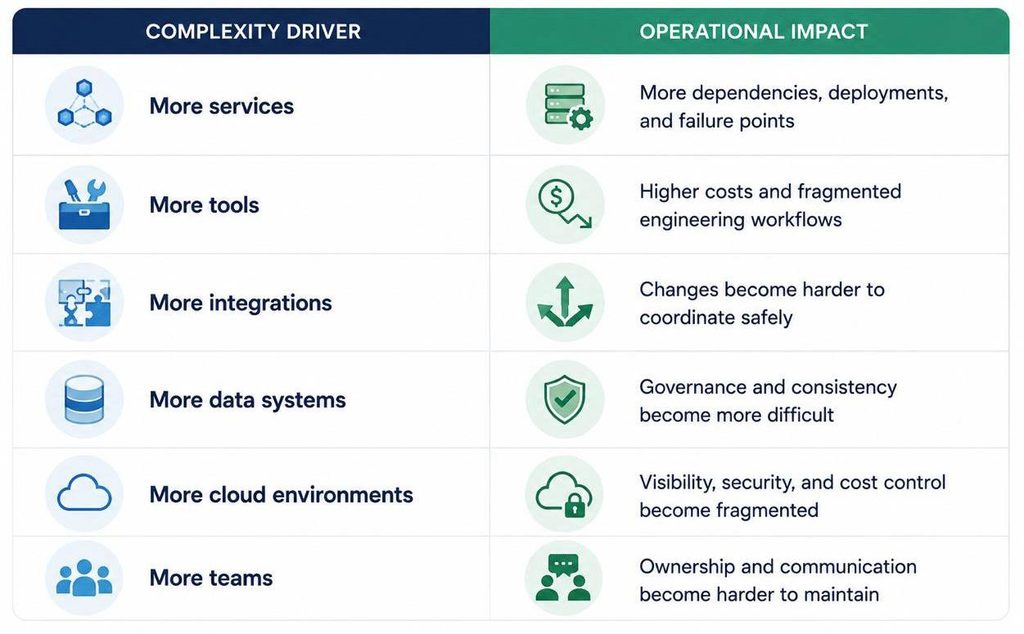
Tool growth creates similar pressure. If 100 engineers lose just 30 minutes per week searching across fragmented tools, documentation, dashboards, or repositories, that represents more than 2,500 hours per year spent navigating the technology environment rather than improving the product. The same effect appears during incidents. A problem that once required checking one application and one database may now require tracing requests across APIs, containers, cloud services, queues, databases, and third-party platforms before the actual source of failure becomes clear.
Microservices Solve One Problem and Create Another
Microservices became popular partly because they allow large applications to be separated into smaller, independently deployable components. This can provide significant advantages. Teams can own individual services, scale workloads independently, choose appropriate technologies, and release changes without deploying an entire application. But distribution introduces operational complexity.
Instead of function calls inside one application, systems communicate across networks. Teams need service discovery, API management, distributed tracing, centralized logging, container orchestration, secrets management, resilience mechanisms, and observability.
Data also becomes more difficult to manage when multiple services own different parts of the business domain. For some organizations, this trade-off is worthwhile. For others, breaking systems into too many small services creates more operational work than business value. The lesson is not that microservices are good or bad.
Architecture should reduce the complexity that matters for the organization rather than follow a particular trend.
Tool Sprawl: When Every Problem Gets Another Platform
Modern engineering teams have access to specialized tools for almost every technical problem.
There are platforms for CI/CD, observability, security, infrastructure, databases, feature flags, incident management, API management, analytics, testing, collaboration, and developer productivity.
Specialization can improve capabilities, but it can also create tool sprawl. Different teams may purchase tools that solve similar problems. Platforms may overlap in functionality. Engineers need to learn multiple interfaces. Data becomes distributed between dashboards. Integrations need to be maintained. The financial impact is only part of the problem.
Every platform becomes another dependency that needs ownership, configuration, permissions, security review, upgrades, documentation, and integration with the rest of the environment. Organizations therefore need to evaluate technology not only by asking “What does this tool provide?” but also “What complexity does this tool introduce?”
Cloud Makes Infrastructure Easier to Create — and Harder to See
Cloud computing dramatically reduced the effort required to provision infrastructure. That flexibility accelerated development, but it also changed how infrastructure complexity grows.
Teams can create databases, storage, compute resources, Kubernetes clusters, serverless functions, queues, networking components, and managed services in minutes. Infrastructure can also be distributed across multiple accounts, regions, and providers.
Creation is easy. Maintaining a complete picture is harder. Organizations may eventually struggle to answer basic questions: Which resources are still necessary? Who owns them? Which applications depend on them? What data moves between environments? Which services are publicly accessible? How much does each product cost?
This is where cloud complexity overlaps with cloud cost optimization, FinOps, security, governance, and observability. The problem is no longer provisioning infrastructure. It is maintaining visibility and control over infrastructure that changes continuously.
Build scalable, manageable systems with Ficus Technologies.
Contact usWhy Complexity Slows Engineering Teams
Complex systems increase the amount of context engineers need before making changes.
A developer may need to understand several services, deployment pipelines, APIs, infrastructure dependencies, security requirements, and data flows before modifying what appears to be a relatively small feature. This increases cognitive load. Engineers spend more time searching documentation, investigating dependencies, switching between tools, asking other teams for information, and determining whether a change is safe.
Onboarding becomes slower because new developers need to understand not only the codebase but also the ecosystem surrounding it. Incidents become more difficult as well. When a request passes through multiple services and platforms, identifying where something failed can require investigation across several logs and monitoring systems. Eventually, system complexity becomes organizational complexity.
More dependencies require more coordination, and more coordination reduces the amount of engineering time available for actual product development.
Standardization Reduces Cognitive Load
One of the most effective ways to manage complexity is reducing unnecessary variation. If every engineering team uses a different deployment process, logging format, monitoring platform, authentication approach, and infrastructure pattern, developers need to learn a new environment every time they move between projects.
Standardization creates predictable foundations. Organizations can provide common CI/CD pipelines, observability tools, infrastructure templates, security controls, API conventions, and development environments. This does not mean every team must build identical systems.
The objective is to standardize the areas where variation provides little business value while preserving flexibility where teams genuinely need different solutions. Good internal platforms make these standards easier to adopt by turning them into reusable capabilities rather than documentation developers need to implement manually. The result is less cognitive overhead and fewer decisions that each team needs to solve independently.
Essential Complexity vs. Accidental Complexity
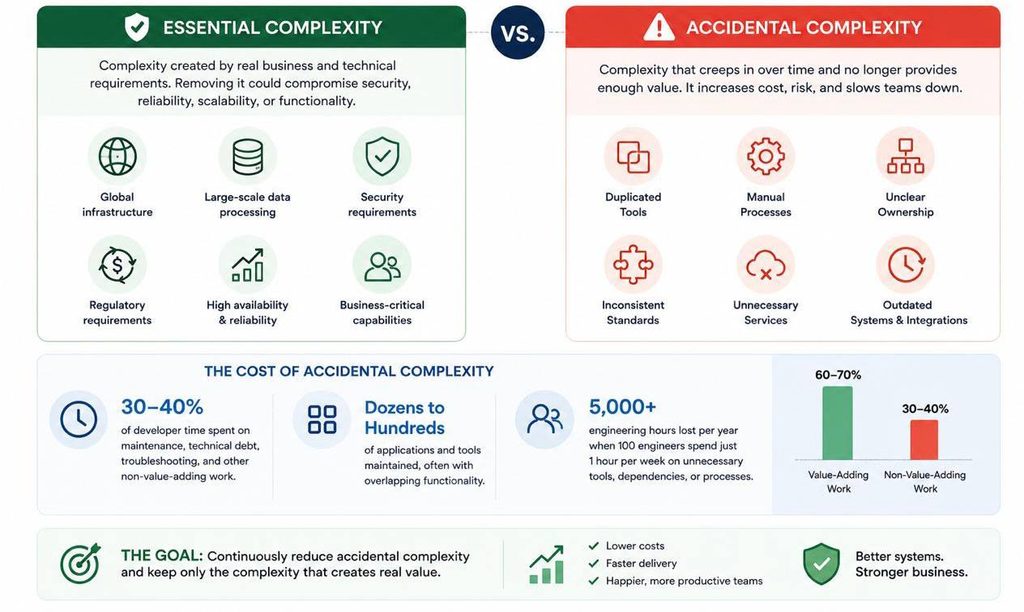
Not all complexity is a problem. Some of it is simply the cost of building sophisticated systems. A global payment platform operating across multiple regions, processing millions of transactions, meeting regulatory requirements, and maintaining high availability will naturally require more infrastructure and engineering controls than a simple internal application.
This is essential complexity — complexity created by real business and technical requirements. Removing it could compromise security, reliability, scalability, or functionality. The bigger problem is accidental complexity.
It appears when organizations accumulate technologies and processes that no longer provide enough value: duplicated tools, unnecessary services, inconsistent standards, manual workflows, outdated systems, unclear ownership, and integrations created years ago but never reconsidered.
The cost can be significant. In complex engineering environments, developers can spend 30–40% of their time on maintenance, technical debt, troubleshooting, and other work that does not directly create new product capabilities. Organizations may also maintain dozens or even hundreds of applications and tools, with overlapping functionality increasing licensing, integration, security, and support costs.
Even small inefficiencies become expensive at scale. If a team of 100 engineers loses only one hour per week navigating unnecessary tools, dependencies, or manual processes, that represents more than 5,000 engineering hours per year.
From Tech Stack to Technology Platform
As organizations mature, they often move away from thinking about technology as a collection of individual tools. Instead, they build common platforms that provide reusable capabilities across engineering teams.
A platform may offer standardized deployment, infrastructure provisioning, observability, authentication, security controls, data access, and development environments through self-service workflows.
This reduces the number of decisions every product team needs to make. Instead of assembling infrastructure from scratch, teams start from a supported foundation and focus their effort on the capabilities that differentiate the product. The result is not necessarily fewer technologies underneath.
The difference is that complexity is absorbed by the platform rather than repeatedly exposed to every developer. This is one of the most important principles for scaling modern engineering organizations: complexity may still exist, but it should live in the right place.
Simplicity is prerequisite for reliability.
Edsger W. Dijkstra
Conclusion
Modern technology stacks are difficult to manage because they are no longer simple stacks. They are interconnected ecosystems of cloud services, applications, APIs, data platforms, infrastructure, security tools, third-party services, and increasingly AI systems. Each technology can provide genuine value while simultaneously introducing new dependencies and operational responsibilities. Organizations cannot solve this by avoiding modern technology. Nor can they eliminate every form of complexity.
The more practical objective is to make complexity visible, intentional, and manageable. That means establishing clear ownership, standardizing common foundations, investing in observability and automation, reducing unnecessary tools, simplifying legacy environments, and designing architectures that allow teams to change systems independently.
The question should not be “How do we eliminate complexity?” It should be “Which complexity is worth maintaining?”
Why Ficus Technologies?
At Ficus Technologies, we help businesses design, modernize, and manage technology environments without allowing complexity to become a barrier to growth. From cloud architecture and DevOps to custom software development, system integration, modernization, and automation, we build technical foundations that remain scalable and manageable as businesses evolve.
Build powerful systems without unnecessary complexity — with Ficus Technologies.
Modern stacks combine cloud services, APIs, SaaS platforms, databases, security tools, infrastructure, and third-party integrations.
No. Some complexity is necessary to support scale, security, reliability, and advanced business requirements.
It increases cognitive load, slows onboarding, creates more dependencies, and makes development, testing, deployment, and troubleshooting more difficult.
Organizations can standardize common workflows, consolidate tools, improve observability, automate infrastructure, clarify ownership, and retire systems that no longer provide enough value.
Yes. Internal platforms can hide infrastructure complexity behind reusable, self-service capabilities, allowing product teams to focus more on building business functionality.






 Success...!