
Artificial intelligence is becoming part of everyday work. Employees use AI to write and summarize information, analyze data, generate code, research ideas, automate repetitive tasks, support customers, and make sense of large volumes of information.
But the most successful use of AI is rarely about replacing people entirely. In practice, the strongest results often come from combining what AI does well — speed, scale, pattern recognition, and automation — with what humans still provide: context, judgment, creativity, accountability, and an understanding of what actually matters to the business.
The challenge is deciding where AI should act independently, where people should remain in control, and where the two should work together.
Companies that get this balance right can increase productivity without creating unnecessary risk. Those that do not may simply automate weak processes, generate more work for employees, or introduce decisions nobody fully understands.
For businesses moving from AI experimentation toward practical adoption, human-AI collaboration is becoming an important part of operating model and workflow design.
- AI works best when roles are clearly defined. Organizations need to decide what AI can do independently and where human review is required.
- Automation is not always the goal. In many workflows, AI creates more value by assisting people rather than replacing the entire process.
- Human judgment remains essential. Context, ambiguity, accountability, and high-impact decisions still require human involvement.
Where AI Actually Adds Value
AI creates the most practical value when it removes work that is repetitive, information-heavy, or time-consuming but still requires human direction. Consider a customer support team. AI can summarize a customer’s history, identify relevant documentation, suggest a response, and classify the request. The employee can then focus on understanding the situation, handling exceptions, and deciding what should actually be communicated.
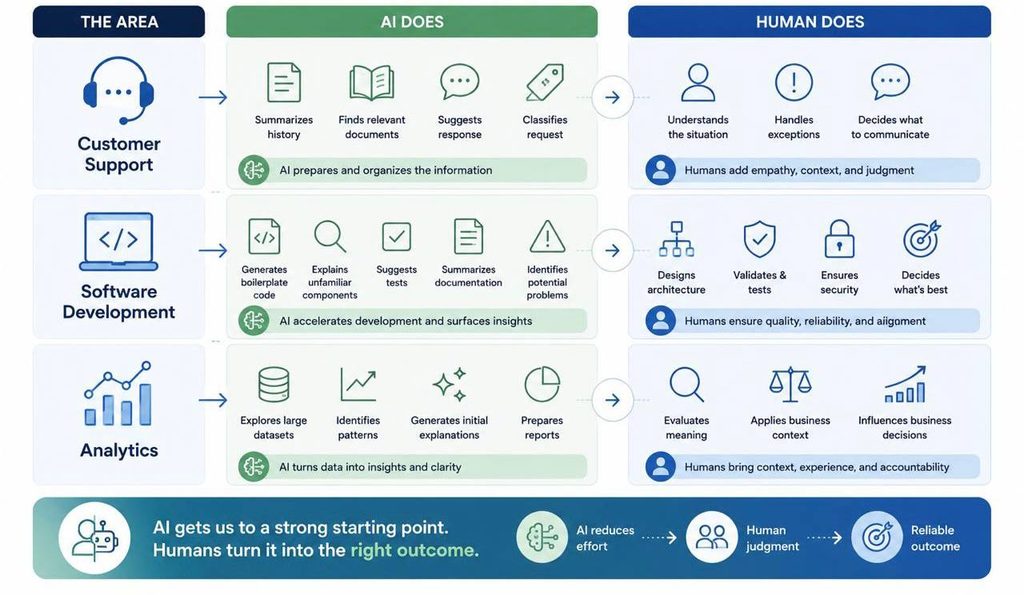
The same model works in software development. AI can generate boilerplate code, explain unfamiliar components, suggest tests, summarize documentation, or identify potential problems. Engineers remain responsible for architecture, validation, security, and whether the solution is appropriate for the system.
In analytics, AI can help employees explore large datasets, identify patterns, generate initial explanations, and prepare reports. Human experts determine whether those patterns are meaningful and how they should influence business decisions. The pattern is consistent: AI reduces the effort required to reach a useful starting point, while humans provide the judgment required to turn that output into a reliable outcome.
The Three Models of Human + AI Collaboration
Not every workflow needs the same relationship between people and AI. In practice, most useful implementations fall into three broad models. AI assists the human. The system generates suggestions, summaries, drafts, or recommendations while the person remains responsible for the final action. This works particularly well for writing, research, coding, analytics, and customer support.
AI acts, human approves. The system prepares or performs an action but requires confirmation before something important happens. This model is useful for financial operations, infrastructure changes, sensitive communications, and other workflows where automation provides speed but mistakes have meaningful consequences.
AI acts independently within defined boundaries. Low-risk, predictable tasks can be automated completely when organizations establish clear rules, permissions, monitoring, and escalation paths. Examples can include classification, routing, routine data processing, or basic operational workflows.
The important decision is not whether a company should “use AI.” It is which collaboration model makes sense for each task.
The Numbers Behind Human + AI Collaboration
The rapid adoption of generative AI has made productivity one of the most closely watched areas of enterprise AI. Research and workplace experiments have shown that AI assistance can produce meaningful improvements in certain tasks, particularly where employees work with language, information, software, or repetitive knowledge processes.
The size of the improvement varies significantly depending on the task, employee experience, workflow design, and quality of the AI system.
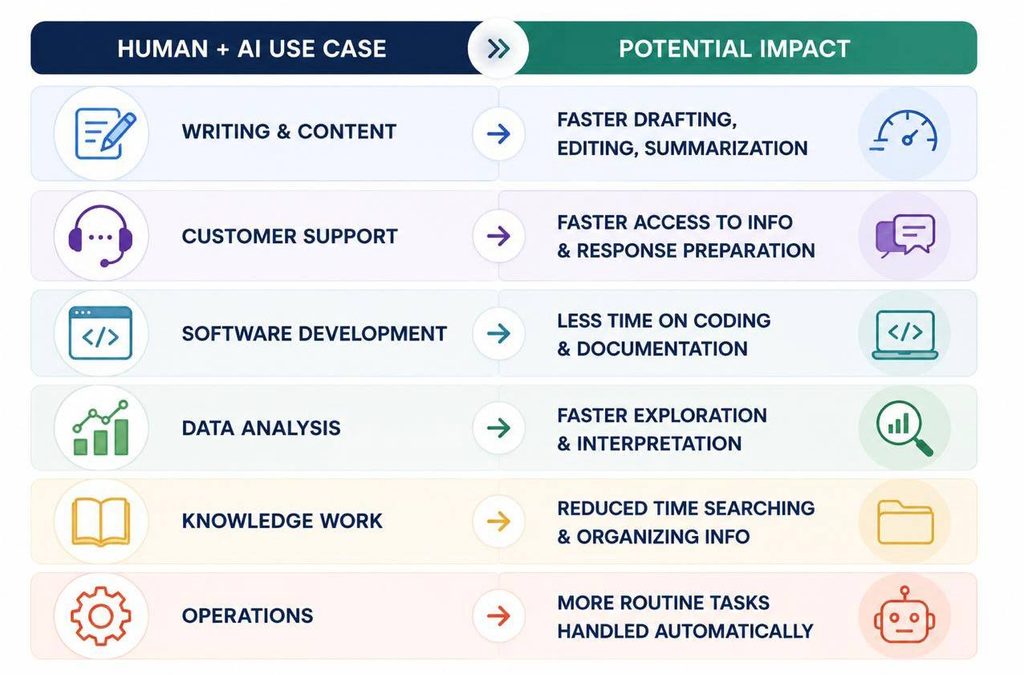
The important point is that productivity gains do not come from AI access alone. Two organizations can deploy the same technology and achieve very different results depending on how it is integrated into workflows. Employees need reliable data, appropriate tools, clear instructions, and an understanding of when AI output needs verification. The competitive advantage therefore comes less from simply having AI and more from designing work around it effectively.
Why Full Automation Is Often the Wrong Goal
Automation sounds attractive because removing human involvement appears to offer the largest efficiency gain. But many business processes contain exceptions, ambiguity, incomplete information, and decisions that depend on context.
Automating the entire workflow can therefore create new problems. An AI system may handle 90% of routine cases correctly while struggling with the 10% that carry the greatest business risk. If employees stop paying attention because the system usually works, those exceptions become even more dangerous. Human involvement is particularly valuable when decisions are difficult to reverse, affect customers significantly, involve sensitive information, or require ethical, legal, or strategic judgment.
The better question is not “Can AI automate this process?” It is “Which parts of this process should AI handle, and where does human judgment create the most value?” This leads to more targeted automation and usually produces a better balance between efficiency and control.
AI Should Reduce Cognitive Load, Not Add to It
One overlooked problem with enterprise AI is that poorly implemented systems can create additional work. Employees may receive AI-generated summaries they still need to verify against original documents. Developers may spend time fixing generated code. Customer support agents may rewrite suggestions that do not match the situation. Managers may receive more reports simply because AI makes reports easier to produce.
In these cases, AI increases output but does not necessarily increase productivity. A useful implementation should reduce the amount of information employees need to process manually.
Instead of generating ten additional insights, AI might identify the two that require attention. Instead of producing a long summary, it might highlight the decision that needs to be made. Instead of giving engineers several possible solutions, it might provide the relevant context and explain the trade-offs.
The objective should be less friction and better decisions, not simply more generated content.
Build smarter human + AI workflows with Ficus Technologies.
Contact usWhere Humans Still Have the Advantage
AI is extremely effective at processing information and identifying patterns, but business decisions often depend on factors that are difficult to represent completely in data.
Humans understand organizational history, relationships, priorities, informal constraints, and consequences that may never appear in the prompt or dataset.
A manager deciding whether to restructure a team needs more than productivity statistics. A salesperson negotiating an important contract needs to understand the relationship with the client. An engineer choosing between architectural approaches needs to consider future strategy, team capabilities, technical debt, and operational realities.
An AI system can recommend an action, but organizations still need people who can explain why important decisions were made and take responsibility for their consequences. This is why human judgment becomes more valuable, not less valuable, as AI handles more routine information processing.
From Copilots to AI Agents
The next stage of human-AI collaboration is moving beyond systems that only suggest information. Copilots primarily assist. Agents can increasingly perform actions.
An AI agent might retrieve information from several applications, update a CRM record, prepare a report, schedule a meeting, create a support ticket, or trigger another business workflow.
This changes the risk model. When AI generates a draft, a mistake can usually be corrected before anything happens. When AI performs an action across business systems, errors can have immediate consequences.
Organizations therefore need stronger permission models, action boundaries, monitoring, logging, confirmation mechanisms, and escalation rules. The most practical agentic systems are likely to operate within clearly defined environments rather than having unlimited autonomy.
An agent might have permission to collect information automatically but require approval before sending it externally. It may prepare a transaction but not execute it. It may modify low-risk records while escalating unusual cases. The more AI can do, the more important control architecture becomes.
Designing Better Human + AI Workflows
Successful AI adoption usually starts with the workflow rather than the technology. Organizations should first understand how work happens today: which steps consume the most time, where employees repeatedly search for information, which decisions require expertise, where errors occur, and which tasks are predictable enough to automate.
AI can then be introduced where it removes meaningful friction. A strong workflow clearly defines the input the AI receives, what the system is expected to produce, which data sources it can access, what actions it can perform, when human review is required, and how exceptions are handled.
Feedback is equally important. Employees should be able to correct outputs, report problems, and influence how the system evolves. Monitoring can then show whether AI is actually reducing cycle time, improving quality, or simply moving work from one part of the process to another.
This turns AI automation from a technology experiment into an operational improvement program.
The Challenges of Human + AI Collaboration
Introducing AI into everyday work creates organizational challenges as well as technical ones. Employees need to understand what AI can and cannot do reliably. Managers need to redesign processes instead of simply adding another tool. Security teams need appropriate controls around data and access. Leaders need to establish accountability through responsible AI governance when AI contributes to decisions.
Trust is another challenge. If employees do not trust the system, they may ignore useful recommendations or verify every output manually, eliminating much of the productivity benefit. If they trust it too much, they may accept incorrect outputs without sufficient review. Organizations therefore need calibrated trust: employees should understand where AI is reliable, where uncertainty exists, and when verification is necessary.
Successful adoption depends on technology, process, and behavior evolving together.
From AI Adoption to AI-Native Work
The first phase of enterprise AI adoption has largely focused on adding AI tools to existing workflows.
Employees write the same reports but use AI to draft them. Developers follow the same development process but use AI to generate code. Support agents follow the same workflow but receive AI-generated responses.
The larger opportunity is redesigning the workflow itself. If AI can summarize information automatically, perhaps employees no longer need to prepare certain reports manually. If an agent can gather information from multiple systems, teams may no longer need several handoffs. If AI can identify routine cases reliably, specialists can focus primarily on exceptions.
This is the difference between using AI inside existing work and redesigning work around AI capabilities. The second approach requires more effort, but it is also where larger productivity gains are likely to emerge.
AI is not going to replace humans, but humans with AI are going to replace humans without AI.
Karim Lakhani, Harvard Business School
Conclusion
Human-AI collaboration works best when organizations stop treating the question as a competition between people and machines. AI is exceptionally useful for processing information, generating first drafts, identifying patterns, automating repetitive steps, and operating at a scale that would be difficult for humans alone.
People remain essential for judgment, context, creativity, accountability, and decisions where consequences matter.
The practical opportunity lies between these strengths. Organizations need to determine which tasks AI should assist, which actions it can automate, where human approval is necessary, and how the entire workflow should change once these capabilities become available. The companies that benefit most from AI will not necessarily be those that automate the most.
They will be the ones that design the best collaboration between human judgment and machine capability.
Why Ficus Technologies?
At Ficus Technologies, we help businesses move AI from experimentation into practical workflows. From AI integration and intelligent automation to custom software, data platforms, cloud systems, and AI-enabled products, we build solutions that combine automation with the visibility and control businesses need.
Turn AI into practical business value — with Ficus Technologies.
Human-AI collaboration combines AI capabilities such as automation and information processing with human judgment, context, creativity, and accountability.
AI is particularly useful for repetitive, information-heavy tasks such as summarization, classification, drafting, data analysis, research support, and routine workflow automation.
Not necessarily. The level of oversight should depend on risk. Low-risk tasks can often be automated, while sensitive or high-impact decisions may require explicit human review.
A copilot primarily assists users with information or recommendations. An AI agent can also perform actions and interact with other systems within defined permissions.
Companies can track outcomes such as time saved, cycle time, throughput, quality, cost, error rates, and customer experience rather than measuring AI usage alone.




 Success...!