AI agents are becoming capable of doing far more than answering questions. They can retrieve information, interact with APIs, update enterprise applications, analyze documents, generate code, trigger workflows, communicate with other agents, and perform multi-step tasks with limited human involvement. That creates a new problem for businesses. Building an individual agent is becoming easier. Coordinating dozens of autonomous systems across real business processes is much harder.
A customer-service workflow may involve one agent interpreting the request, another retrieving account information, another evaluating policies, and a separate execution component approving or performing an action. An engineering workflow may combine planning, coding, testing, security review, and deployment agents. Finance, IT operations, procurement, and analytics can develop similar architectures. Once autonomous systems begin working together, intelligence alone is no longer enough. Businesses need a layer that determines which agent should act, what information it receives, which tools it can use, how authority is delegated, when another agent should take over, and when the workflow is finished. That layer is AI agent orchestration. Orchestration turns collections of individual agents into coordinated systems. It manages execution order, state, context, permissions, handoffs, failures, and human intervention so that autonomy remains useful rather than chaotic.
The challenge is similar to other distributed architectures. More specialized components can improve flexibility and scalability, but they also create more dependencies and more opportunities for coordination failure. The goal is therefore not maximum autonomy. It is controlled autonomy across the entire workflow.
- Agent orchestration coordinates autonomous systems across complete workflows.
- Routing, shared state, context, permissions, and termination are core architectural concerns.
- More agents can create more capability but also more latency, cost, and failure points.
Orchestration Turns Individual Agents Into a System
A single AI agent can manage a surprisingly complex task. It can interpret a request, decide which tool to use, retrieve information, evaluate the result, and continue until it reaches an answer. For relatively contained workflows, this may be the simplest and most effective architecture.
Problems begin when the workflow becomes larger than one reasoning context can comfortably manage. A business process may involve several domains, different systems, different permission levels, and multiple stages of decision-making. One agent can technically handle all of those responsibilities, but doing so creates an increasingly complicated instruction set and a very broad set of tools and permissions. Agent orchestration separates the workflow from the individual agent.
Instead of expecting one autonomous system to understand everything, the orchestration layer determines how work moves between specialized capabilities.
Consider an insurance claim workflow. One agent might extract information from submitted documents. Another checks policy coverage. A risk agent evaluates unusual patterns. A customer-communication agent prepares a response. A final execution service updates the claim system after the required approvals have been completed. The value does not come from having four agents instead of one.
It comes from giving each component a clear responsibility and coordinating them through a predictable workflow. The same principle applies to software development. A planning agent can interpret requirements, a coding agent can implement changes, a testing agent can evaluate them, and a security agent can inspect the result before anything reaches production.
Orchestration determines when each stage starts, which outputs become inputs to the next stage, what happens when validation fails, and whether the workflow can continue automatically. This creates an important separation of responsibilities. The agent handles reasoning within a task. The orchestration layer handles how the overall system operates. That distinction becomes increasingly important as agentic AI moves into business-critical environments.
Routing, Handoffs, and State Become the Core Architecture
Coordinating autonomous systems requires more than sending messages between agents. The orchestrator needs to determine who should perform each task. Sometimes routing can be simple. A billing question always goes to the billing agent. A code-security review always goes to the security agent. Other workflows require dynamic routing. A customer request may first be classified and then directed to a sales, technical-support, finance, or compliance agent depending on its content. An engineering agent may decide whether a problem requires code modification, infrastructure changes, or additional investigation. Dynamic routing provides flexibility, but it also creates unpredictability.
The same input may take slightly different paths depending on how an agent interprets the situation. Businesses therefore need boundaries around which routes are allowed and which transitions require additional validation. Handoffs create another challenge. When one agent passes work to another, it needs to transfer enough information for the next agent to continue effectively. Sending the complete conversation and every intermediate reasoning result is rarely ideal. It increases token usage, latency, and cost. It also creates a security problem because information that one agent legitimately accessed may spread to agents that do not need it. Strong orchestration passes minimum useful context.
A compliance agent evaluating a contract may need the contract text and relevant policy rules. It probably does not need the complete internal conversation that led another agent to request the review.
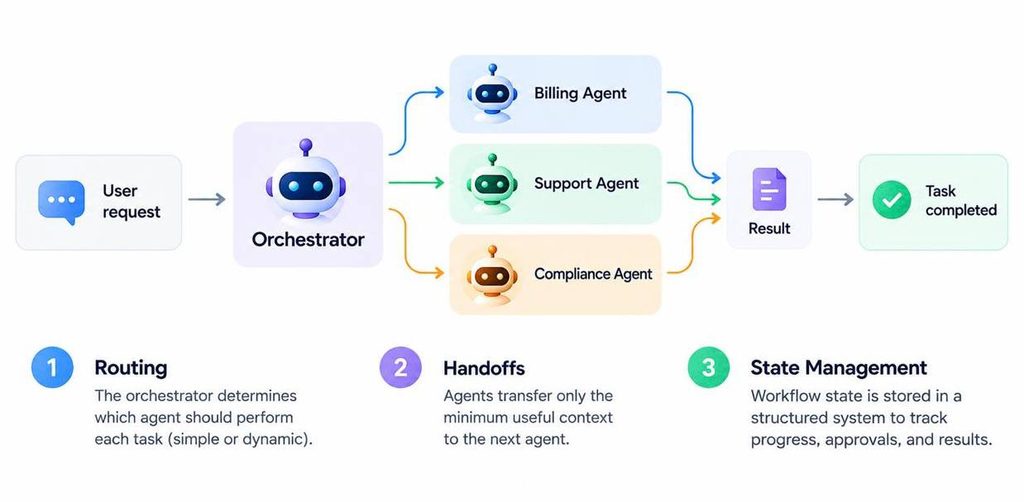
A deployment agent may need an approved build, environment identifier, and deployment instruction. It does not need the entire code-generation history. State management becomes critical once workflows extend across multiple steps. The system needs to know which tasks have completed, which actions were approved, which results are valid, what remains pending, and whether a failed operation can safely be retried. This information should not exist only inside an AI conversation.
Important workflow state should be recorded in structured systems that can be queried, validated, and audited independently of the model. Otherwise, agents may make decisions based on incomplete or outdated conversational context. The architecture increasingly resembles a workflow engine combined with autonomous reasoning. AI decides how to solve parts of the problem. Structured state ensures the overall process remains consistent.
Autonomous Workflows Need Limits and Clear Termination
One of the less obvious challenges of agent orchestration is knowing when an autonomous workflow should stop. Human workflows contain natural stopping points. A manager approves a request, a ticket reaches a final state, or an employee decides that enough information has been collected.
Agents do not necessarily have the same intuition. A research agent may decide that it needs another source. The new source raises another question, which triggers another search. An analysis agent may repeatedly request additional validation because it remains uncertain. In a multi-agent environment, the problem can become even larger. Agent A asks Agent B for additional analysis. Agent B asks Agent C for supporting information. Agent C sends the result back, but Agent A decides the evidence is still incomplete and starts the cycle again. Without orchestration limits, this can create expensive execution loops. Every additional step consumes model tokens, API calls, compute resources, and time.
Agent orchestration therefore needs explicit operational boundaries. These can include maximum workflow duration, retry limits, delegation depth, tool-call limits, model-spending budgets, or maximum numbers of agent interactions. The system also needs clear completion criteria.
A research workflow might stop after sufficient independent sources have been collected. A support workflow ends once the issue has been resolved or escalated. A software workflow stops once tests pass and required approvals are complete. Not every termination rule needs to be controlled by AI.
In many cases, deterministic conditions are safer. For example, the system may allow a testing agent three attempts to fix a failed build. After the third failure, the orchestrator automatically escalates the workflow to an engineer rather than allowing the agent to continue indefinitely.
This combination is important. Agents provide flexible reasoning. The orchestration layer provides predictable boundaries. The same approach can control cost. Businesses can define different execution budgets depending on workflow value. A high-value fraud investigation may justify extensive reasoning and multiple specialist agents. A simple internal support request should probably not trigger twenty model calls. Successful orchestration therefore includes economic controls as well as technical controls. Autonomous systems need to know not only what they can do, but how much work they are allowed to perform before another decision is required.
Security Has to Follow Delegated Authority
Agent orchestration introduces a difficult security question: When one agent asks another agent to perform an action, whose authority is being used? This becomes particularly important when agents have different permissions. Imagine a research agent with internet access but no permission to modify enterprise systems. It sends information to an operations agent that can update production infrastructure. If the operations agent automatically executes every instruction it receives, the research agent effectively gains indirect production privileges.
The architecture may appear to enforce separation while actually allowing privilege escalation through delegation. Secure orchestration needs to preserve the authority chain. At every stage, the system needs enough information to determine whether the requested action is still within the original authorization. The receiving agent should not assume another agent is trustworthy simply because both belong to the same platform. Each agent needs a distinct identity and a defined set of capabilities.
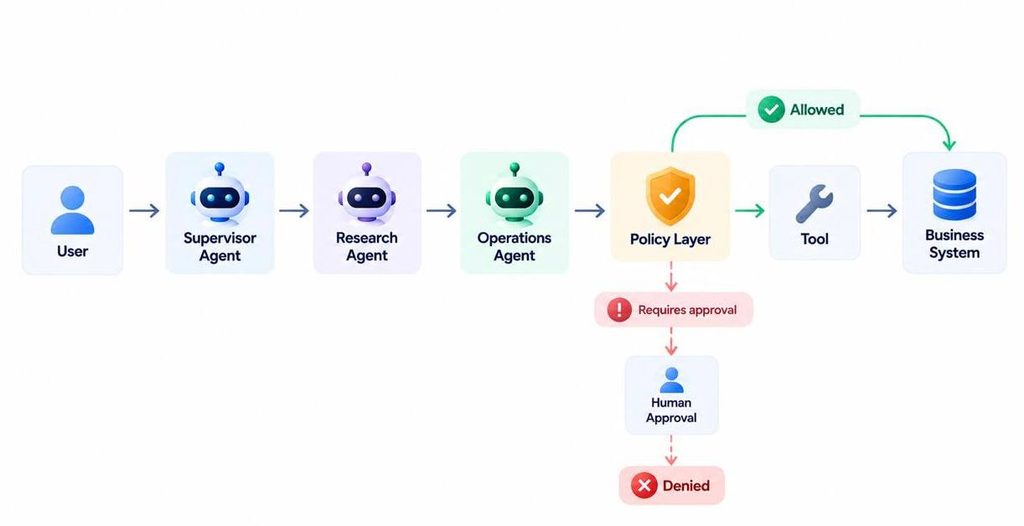
Permissions should be associated with tasks rather than granted broadly across the entire agent environment. This becomes particularly important for actions such as sending external communications, changing customer information, transferring money, modifying access permissions, deleting data, or deploying software. A planning agent may recommend the action. An execution agent may technically perform it. A policy layer should determine whether the action is actually permitted. This keeps AI reasoning separate from final authorization. Human approval can remain part of the architecture where appropriate. The goal is not to require a person for every agent interaction. That would eliminate much of the efficiency autonomous systems can provide. Instead, approval can be proportional to risk. Routine reads may execute automatically. Low-impact updates may pass through deterministic policy checks. Financial, destructive, regulatory, or externally visible actions may require stronger validation or explicit human confirmation. Orchestration is therefore also where AI governance becomes executable. Policies do not remain documents describing what agents should do.
They become controls determining which transitions, tool calls, and actions the system will actually allow.
Observability Becomes Essential as Workflows Become Autonomous
Traditional application monitoring focuses on services, requests, infrastructure health, errors, and latency. Agent orchestration requires another layer of visibility. Organizations need to understand how autonomous decisions move through the system. For an important workflow, teams should be able to reconstruct the original request, which agent received it, why another agent was selected, what context was transferred, which tools were called, what permissions were used, which validations occurred, and how the final action was produced. Without that visibility, debugging becomes extremely difficult.
Suppose an agentic workflow produces an incorrect financial report. The error may have originated in a data-retrieval tool, a specialist agent’s interpretation, an incorrect handoff, stale shared state, or a final synthesis step. Looking only at the final response does not reveal enough. The same problem appears in security investigations. If an agent modifies a customer record incorrectly, the organization needs to determine whether the user requested the change, the supervisor agent inferred it, another agent supplied incorrect information, or an external tool returned manipulated content.
Observability therefore needs to connect actions across the complete execution chain.
Cost also needs to be observable. Multi-agent workflows can become expensive because each delegation creates another model interaction. A workflow that appears small from the user’s perspective may involve dozens of calls across several models and tools. Businesses should monitor cost per completed workflow rather than model usage alone. The same applies to performance.
Adding specialist agents may increase quality while also increasing latency. If a workflow requires eight sequential agent calls, even individually fast responses can create an unacceptable user experience.
Useful orchestration metrics can include workflow completion rate, escalation rate, average execution time, tool failures, agent retries, number of handoffs, human interventions, and cost per successful task.
The objective is not to measure how autonomous the system appears. It is to measure whether the complete workflow performs better than the process it replaced.
The Best Orchestration Combines AI With Deterministic Systems
One of the biggest mistakes in agent architecture is assuming that every part of the workflow should become autonomous. AI is particularly useful when a task involves interpretation, ambiguity, language, planning, or adapting to changing information. Many other operations are better handled deterministically. Authentication should not depend on an AI model deciding whether credentials look legitimate. Permission checks should be enforced by an authorization system. Payment limits should be defined by policy. Database transactions should maintain consistency independently of model reasoning. A strong agent architecture therefore combines two worlds. AI manages flexible reasoning.
Traditional software manages predictable execution.Consider an AI procurement workflow.
An agent may analyze supplier proposals, compare contractual terms, identify risks, and recommend a vendor. But vendor creation, payment setup, contract approval, and financial limits can remain governed by existing enterprise systems and deterministic controls. The agent contributes intelligence without replacing every business rule. This hybrid model also improves reliability.Agents can fail without necessarily causing irreversible effects because critical actions remain behind controlled interfaces.
It makes systems easier to test as well. Reasoning quality can be evaluated separately from execution policies. Businesses can replace one model with another without redesigning the authorization layer or workflow state management. This separation becomes increasingly valuable as AI technology changes.
Today’s strongest model may not be the strongest model next year. Organizations that embed model-specific assumptions throughout their workflow risk constant redesign.
An orchestration layer can provide a more stable architecture. Different models can be assigned to different tasks. Low-cost models can handle classification or routine processing. More capable models can be reserved for difficult reasoning. Specialized models can perform coding or document analysis. Businesses are therefore not only orchestrating agents.
They are increasingly orchestrating models, tools, data, deterministic services, and human decision points inside one workflow. That is where agent orchestration becomes a genuine enterprise capability rather than another AI experiment.
Coordinate AI agents around real business outcomes – with Ficus.
Contact usConclusion
As AI agents become more capable, the challenge is shifting from building autonomous components to coordinating them reliably. A successful agentic system needs to know which agent should act, what context it should receive, which tools it can use, how authority is delegated, when the workflow should stop, and when a human or deterministic system should take control. This makes orchestration one of the most important architectural layers in enterprise AI. Without it, additional agents can create duplicated work, execution loops, uncontrolled permissions, rising costs, inconsistent state, and increasingly difficult debugging. With strong orchestration, specialization becomes useful.
Businesses can combine research agents, operational agents, domain specialists, validators, deterministic services, and human approval into workflows where each component performs the work it handles best. The objective is not to automate every decision. It is to coordinate autonomy so that the complete system remains predictable where it needs to be and flexible where it creates value.
As companies move from individual copilots toward networks of autonomous systems, the quality of their orchestration architecture may matter as much as the intelligence of the models themselves.
Why Ficus Technologies?
At Ficus Technologies, we help businesses turn autonomous AI capabilities into production-ready systems built around real operational workflows. Agent orchestration requires more than connecting several models. It involves workflow architecture, API integration, identity and access management, shared state, cloud infrastructure, observability, data platforms, security controls, and reliable connections to the systems where business actions actually happen. Our expertise across AI development, custom software, cloud architecture, DevOps, API integration, data engineering, and cybersecurity allows us to design agentic platforms where autonomy operates inside clear technical boundaries. Whether the right solution uses a single agent, multiple specialized agents, deterministic services, or human approval points, the architecture should remain understandable, secure, and scalable as the system grows. Coordinate autonomous AI around real business outcomes — with Ficus Technologies.
AI agent orchestration is the coordination layer that manages how agents, tools, models, and workflows interact to complete a broader task.
Not exactly. Multi-agent systems contain multiple agents, while orchestration manages how those agents are routed, coordinated, monitored, and controlled.
No. Simple, contained agents may work effectively without a separate orchestration layer. Orchestration becomes more valuable as workflows involve multiple agents, tools, stages, or permission boundaries.
The system can enforce retry limits, workflow budgets, maximum delegation depth, timeouts, and explicit completion or escalation conditions.
Delegation can be useful, but permissions should remain constrained by the original authorization and independently checked before sensitive actions are executed.
Useful metrics include successful workflow completion, execution time, cost per task, escalation rates, retries, failed tool calls, human interventions, and business outcomes.




 Success...!