AI agents are becoming more capable, but capability does not automatically mean that one agent should handle every task.
A single agent can research information, call APIs, analyze documents, interact with business systems, and execute multi-step workflows. As the scope of the task grows, however, the agent also has to manage more context, more tools, more permissions, and more decisions at the same time. Eventually, the architecture becomes difficult to control.
Multi-agent systems take a different approach. Instead of building one increasingly powerful agent, organizations can divide responsibility between several specialized agents that collaborate toward a shared objective. One agent may plan the workflow, another may retrieve information, another may perform analysis, while a separate agent executes approved actions or validates the result.
The idea resembles how human teams operate. Companies rarely expect one employee to perform research, software engineering, financial analysis, legal review, security validation, and project management simultaneously. Different specialists contribute to the same outcome while working within their own responsibilities.Applied correctly, multi-agent architecture can improve specialization, parallel execution, scalability, and control. Applied poorly, it can create a network of autonomous systems that repeatedly communicate, duplicate work, consume resources, and make it increasingly difficult to understand who made which decision. The real question is therefore not whether multiple AI agents are more advanced than one. It is when additional agents create enough value to justify the additional complexity.
- Multi-agent systems divide complex work between specialized autonomous components.
- More agents do not automatically produce better results.
- Coordination, shared context, permissions, and failure handling become major architectural concerns.
From One General Agent to a Team of Specialists
The simplest agentic architecture starts with one AI agent connected to several tools. The agent receives a goal, decides how to approach it, selects tools, evaluates results, and continues until the task is completed. For many workflows, that is enough. A customer-support agent can search documentation, retrieve an order, summarize account information, and create a ticket without requiring several independent agents. A research assistant may search multiple data sources and prepare a report inside one reasoning process. Adding additional agents to these relatively contained workflows can increase cost and complexity without significantly improving the result. Problems begin when the responsibilities of a single agent become too broad. Imagine an enterprise agent responsible for analyzing a potential customer. It may need to research the company, analyze financial information, evaluate technical requirements, identify relevant decision-makers, review previous CRM activity, prepare a sales strategy, generate personalized communication, and update business systems. One agent can theoretically perform the complete workflow.
But the system must now manage many tools, large amounts of context, different security levels, and several distinct reasoning tasks. Instructions become longer, permissions become broader, and failures become harder to isolate. A multi-agent architecture separates those responsibilities.
A research agent might collect external and internal information. An analysis agent can evaluate the data against defined business criteria. A CRM agent can retrieve or update structured records. A communication agent may prepare outreach. A supervisor agent coordinates the process and decides which specialist should work next. Each agent receives a narrower responsibility and can operate with tools and instructions optimized for that specific function. This specialization can improve consistency because the system no longer asks one model context to handle every part of the workflow simultaneously. It can also reduce permission exposure. The research agent does not need write access to the CRM, while the communication agent may not need access to confidential financial information. The architectural shift is therefore not simply from one agent to many agents.
It is from a single autonomous decision-maker toward a distributed system of specialized capabilities. That distinction matters because multi-agent systems begin to resemble software architecture more than individual AI applications.
Coordination Becomes the Core Architectural Problem
Once multiple agents participate in a workflow, coordination becomes as important as intelligence.
Agents need to know which tasks belong to them, when another agent should take over, what information needs to be transferred, and when the overall objective has been completed. Without clear coordination rules, multiple agents can easily perform the same work, contradict one another, or repeatedly delegate tasks back and forth. Several coordination models can be used. A supervisor model places one agent in charge of the overall workflow. It interprets the goal, assigns tasks to specialized agents, collects their results, and decides what happens next. This structure is relatively easy to understand because responsibility remains centralized. A sequential model moves work through a predefined chain. One agent performs research, another analyzes the result, another validates it, and another executes the final action. The sequence resembles a software pipeline and can work well for predictable business processes. More dynamic systems can allow agents to select collaborators or delegate tasks themselves. This increases flexibility, but it also makes behavior less predictable because the execution path may change between runs. The architectural choice depends on the problem. Highly regulated workflows usually benefit from more explicit orchestration. Exploratory research or complex problem-solving may benefit from greater flexibility. In both cases, organizations need clear rules for ownership and termination. Termination is particularly important.
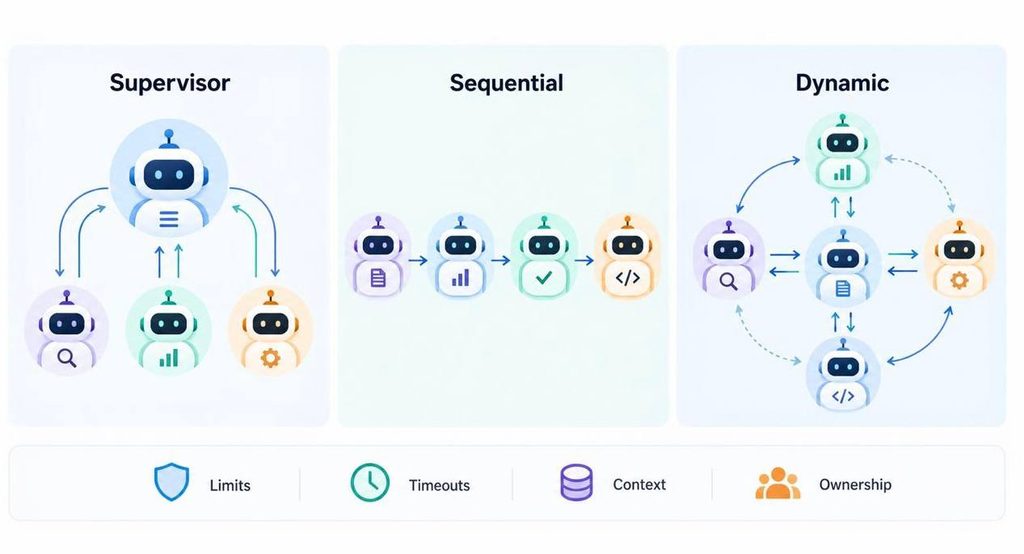
An agent may decide that additional research is necessary and ask another agent to continue. That agent may return incomplete information, causing the first agent to request another attempt. Without limits, multi-agent workflows can create loops that consume tokens, compute resources, API calls, and time without significantly improving the answer. Effective orchestration therefore needs constraints such as maximum delegation depth, execution budgets, retry limits, timeout rules, and clear definitions of task completion. Shared context creates another challenge. Agents need enough information to collaborate, but copying the entire conversation and every intermediate result between all agents creates unnecessary cost and increases the possibility of irrelevant or sensitive information spreading across the system. Strong architectures pass the minimum useful context.
A financial-analysis agent might receive structured revenue data and the analysis objective rather than the complete customer conversation. A deployment agent might receive the approved deployment package and target environment rather than the research history that led to the decision.
Multi-agent architecture therefore requires careful decisions about who knows what, who decides what, and who can ask whom to act.
More Agents Create More Trust Relationships
A single AI agent already introduces questions about identity, permissions, data access, and tool usage. Multi-agent systems multiply those questions because authority can move between autonomous components. Consider a supervisor agent that asks a finance agent to analyze a transaction. The finance agent then requests customer information from another agent and sends its result to an execution agent. The final action may involve several identities and several different permission boundaries. Security teams need to understand not only which agent performed the final operation but also which agent requested it, where the original instruction came from, and which authority was delegated along the way. This makes agent-to-agent communication a new trust layer. One agent should not automatically trust another simply because both belong to the same application. A compromised or manipulated agent could otherwise use another agent as a path toward capabilities it does not possess directly.
Imagine a research agent with internet access but no production permissions. If it can instruct a privileged operations agent without additional authorization, the separation between those agents provides little meaningful security. Delegation therefore needs boundaries. Each agent should have a distinct identity, explicitly defined capabilities, and clear rules describing which other agents it is allowed to communicate with. The receiving agent should independently verify whether the requested operation is permitted rather than assuming that another agent’s instruction is trustworthy.
Permissions should also remain connected to the original authority. If an employee asks an AI system to perform a task, an internal chain of agents should not gradually gain more access than that employee or workflow was originally allowed to use. Data boundaries matter as well.
A compliance agent may require access to sensitive policies that a marketing agent should never receive. An HR agent may process employee information that should not automatically become available to other agents simply because they participate in the same workflow.
Agent specialization can actually improve security if each agent receives only the information and permissions required for its role.
But this benefit appears only when access boundaries are intentionally designed. Without them, a multi-agent platform can become a network through which data and authority travel much more freely than organizations intended.
Multi-Agent Systems Create Value in the Right Workflows
Not every complicated workflow requires multiple agents. The strongest use cases usually contain tasks that can be separated into clearly different responsibilities, require different tools or expertise, or benefit from parallel execution. Software development provides a good example.
One agent can analyze requirements, another can generate code, another can review security implications, and another can test the implementation. A coordinating agent can evaluate the results and decide whether another development iteration is necessary. Research workflows also fit naturally.
Several agents can investigate different sources or hypotheses simultaneously before a synthesis agent combines the findings. Instead of one model performing a long sequential research process, the system distributes exploration across specialized workers. Customer operations can use similar patterns. A support agent may understand the customer request, while specialized agents retrieve billing information, evaluate technical issues, analyze previous interactions, or prepare possible resolutions. Sensitive actions such as refunds or account changes can remain controlled by separate execution agents with stricter permissions. Supply chain, finance, cybersecurity, and IT operations can also contain tasks that benefit from specialization because they combine monitoring, analysis, decision-making, and execution.
However, the multi-agent approach becomes less attractive when responsibilities are artificial.
If three agents perform nearly identical reasoning and repeatedly exchange results, the architecture creates communication overhead rather than specialization. Latency increases because each additional agent introduces another model call. Cost rises because context and instructions need to be processed repeatedly. Reliability can also decline. Suppose five sequential agents each perform their step correctly 95% of the time. The overall workflow does not automatically achieve 95% reliability because each stage introduces another opportunity for error.
The system also becomes more difficult to debug. With one agent, teams can inspect one reasoning and tool-execution path. In a multi-agent workflow, they may need to reconstruct interactions across several independent contexts to determine where an incorrect assumption first appeared.
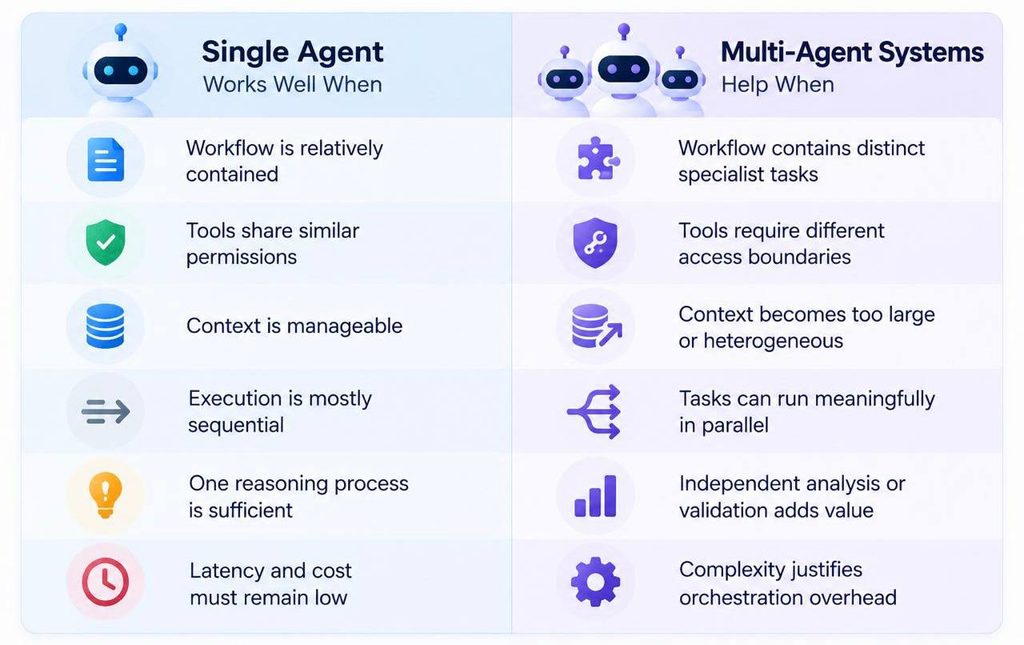
A good rule is to start with the simplest architecture capable of performing the task reliably. Additional agents should solve a specific problem, not simply make the system appear more sophisticated.
Reliability Depends on Clear Responsibilities and Shared State
Multi-agent systems behave like distributed systems, and many familiar distributed-system problems appear quickly.
Agents may operate with different versions of information. One agent may update a customer record while another continues reasoning based on the previous state. Two agents may attempt to modify the same resource simultaneously. An external API may fail halfway through a workflow after several earlier actions have already succeeded. These situations create consistency problems. Businesses therefore need a reliable way to represent shared workflow state. The state should identify the task being performed, which steps are completed, which agent performed them, what data was produced, which actions remain pending, and whether a previous operation can safely be retried. Without structured state management, agents may rely heavily on conversational history to understand what has happened. That becomes fragile at scale. Critical business operations should not depend entirely on an AI agent remembering from natural-language context that another agent already transferred money, sent a message, or modified a database.The underlying platform should record important state explicitly. Idempotency becomes important as well. If an agent retries a failed request, the system needs to know whether performing the action again is safe. Repeating a search usually creates little risk. Repeating a payment, refund, notification, or infrastructure deployment can have serious consequences. Observability needs to follow the complete workflow. For each important execution, organizations should be able to understand the original request, which agents participated, what each one received, which tools they invoked, what decisions were made, which actions required approval, and how the final result was produced. That visibility helps with debugging, but it also matters for security and governance. Multi-agent systems can produce useful outcomes through execution paths developers did not anticipate. Observability is how organizations understand whether those paths remain acceptable. Reliability therefore depends less on making every agent individually perfect and more on designing an architecture that expects individual components to occasionally fail. Retries, validation, fallback paths, approval checkpoints, state management, execution limits, and independent verification all become part of the system. The strongest multi-agent platforms assume that individual agents can make mistakes while ensuring that those mistakes do not automatically become irreversible business actions.
Building Multi-Agent Systems Without Creating Agent Sprawl
As companies begin experimenting with agentic AI, there is a risk of repeating a familiar technology pattern.
One team creates a research agent. Another creates a CRM agent. A third develops a security agent. Different departments connect separate models, tools, APIs, and data sources. Soon the organization has dozens or hundreds of agents without a clear understanding of which ones exist or how they interact. This is agent sprawl. The problem resembles SaaS sprawl and cloud sprawl, but autonomous systems create an additional concern because agents may actively interact with one another and with business infrastructure. Organizations therefore need governance before the number of agents becomes difficult to manage. Every production agent should have a defined purpose, responsible owner, approved tools, permission scope, data classification, model configuration, and lifecycle. Teams should know whether the agent is active, which workflows depend on it, and what would happen if it were disabled. Reusable infrastructure can significantly reduce complexity.
Instead of every team implementing its own agent communication, secrets management, authorization, monitoring, and approval logic, businesses can provide shared platform capabilities. A common agent platform might provide identity, access policies, tool registration, shared state, logging, execution budgets, human approval mechanisms, and communication standards between agents. This makes security and reliability easier to enforce consistently. It also makes agents easier to replace. Agent architecture should avoid creating unnecessary dependence on a single model, tool, or implementation whenever possible. A research agent should be defined primarily by its capability and interface rather than by one specific model provider. The same principle applies to communication between agents. Stable interfaces allow the underlying implementation to change without forcing the entire workflow to be redesigned. This becomes particularly important as organizations experiment with different models. One model may perform better at coding, another at long-context analysis, and another may provide lower-cost processing for repetitive tasks. Multi-agent systems can potentially use different models for different responsibilities. That flexibility is one of their strongest architectural advantages.
It also means that the real value of the system increasingly moves away from the individual AI model and toward the orchestration, permissions, data, tools, and operating model surrounding it.

Turn specialized AI agents into one coordinated business system.
Contact usConclusion
Multi-agent systems represent an important evolution in agentic AI, but they are not automatically the next step for every AI application.
A single well-designed agent can handle many workflows more efficiently and with less operational complexity. Additional agents become valuable when a problem genuinely benefits from specialization, parallel execution, independent validation, different permission boundaries, or separation of responsibilities. Once that threshold is crossed, however, the architecture changes substantially. Organizations are no longer managing one AI model connected to tools. They are managing a distributed system of autonomous components that exchange information, delegate authority, share state, and participate in business workflows. Coordination becomes critical. Identity and access boundaries become more complicated. Observability needs to follow decisions across several agents. State needs to remain consistent. Costs and execution loops need limits.
The goal should therefore not be to create the largest possible team of AI agents. It should be to create the smallest set of specialized agents required to complete the workflow reliably, securely, and efficiently. When one agent is no longer enough, adding another can create significant value. But every additional agent should have a reason to exist.
Why Ficus Technologies?
At Ficus Technologies, we help businesses move agentic AI beyond isolated experiments and into production systems built around real business workflows. Multi-agent architecture requires more than connecting several AI models together. The system needs orchestration, API integration, secure identities, scoped permissions, reliable state management, observability, cloud infrastructure, and clear boundaries around which actions agents can perform independently. Our experience across AI development, custom software, cloud architecture, data platforms, API integration, DevOps, and cybersecurity allows us to design agentic systems as complete software platforms rather than disconnected AI features.
Whether the right architecture requires one agent, several specialized agents, or a combination of AI and deterministic services, the objective remains the same: build a system that creates measurable business value without introducing unnecessary complexity. Turn autonomous AI into coordinated business capability – with Ficus Technologies.
A multi-agent system uses several autonomous or semi-autonomous AI agents that collaborate, delegate tasks, or perform specialized roles toward a shared objective.
No. A single agent is often simpler, cheaper, and easier to control. Multiple agents become useful when specialization, parallel work, independent validation, or separate permissions provide clear benefits.
Agents can communicate through orchestration frameworks, structured messages, shared workflow state, APIs, queues, or other controlled communication mechanisms.
They can be. Additional agents usually mean more model calls, more context processing, and additional infrastructure. The extra cost should be justified by better workflow performance or specialization.
One major risk is uncontrolled delegation of authority. An agent with limited permissions should not be able to indirectly gain broader access by asking another agent to perform privileged actions.




 Success...!