
Cloud was supposed to simplify infrastructure. In 2026, for many organizations, it has done the opposite.
As companies rapidly adopt cloud services, tools, and platforms, a new problem is emerging: Cloud sprawl. What starts as flexibility quickly turns into complexity — making systems harder to manage, secure, and optimize.
DevOps and platform engineering teams.
Companies operating multi-cloud or hybrid environments.
Organizations struggling with cloud costs and visibility.
- Cloud sprawl increases complexity and reduces visibility.
- Uncontrolled growth leads to higher costs and security risks.
- The problem is not cloud — it’s lack of governance.
- Managing cloud requires strategy, not just tools.
What Cloud Sprawl Really Means
Cloud sprawl occurs when cloud resources grow faster than the organization’s ability to manage them.
At first, it looks like progress. Teams deploy new services, spin up environments, experiment with tools, and integrate platforms independently. This flexibility is one of the biggest advantages of cloud.
But without coordination, this growth becomes uncontrolled. Different teams use different providers. New services are added without standardization.
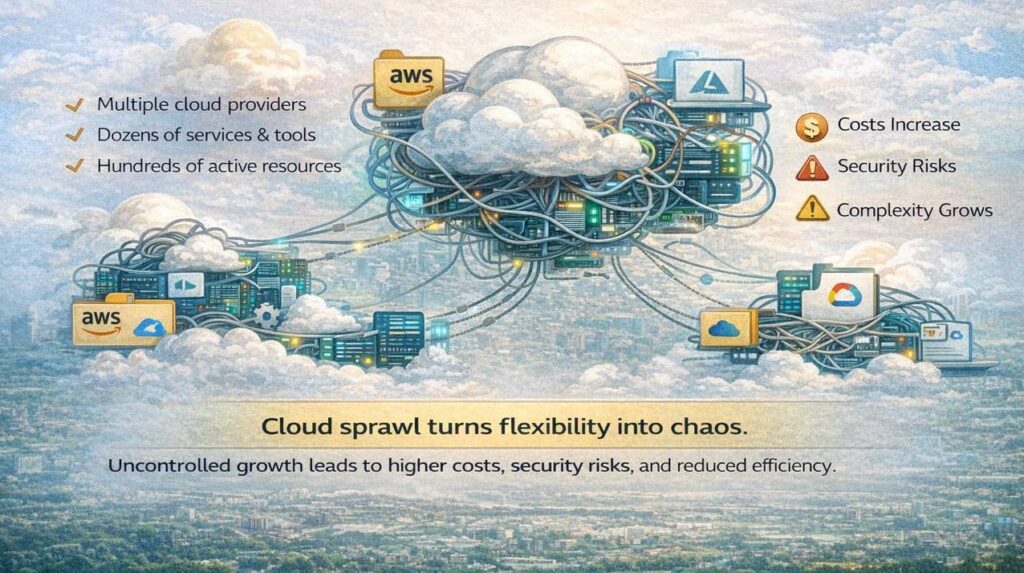
Resources are created quickly — but rarely reviewed or removed. Over time, infrastructure becomes fragmented.
Instead of a unified system, organizations end up with a complex web of disconnected environments:
- multiple cloud providers
- dozens of tools and platforms
- hundreds — sometimes thousands — of active resources
The problem is not scale itself. It is lack of visibility and control. When no one has a complete picture of the infrastructure, decision-making becomes reactive instead of strategic.
Why It Happens
Cloud sprawl is not accidental — it is a result of how organizations scale.
One of the main drivers is decentralization. Cloud allows teams to provision resources independently. While this increases speed, it reduces control.
Speed is another factor. Teams prioritize fast deployment over long-term structure. Resources are created quickly — but rarely cleaned up.
There is also a tooling problem. Different teams adopt different tools, platforms, and services, leading to inconsistency across the organization.
Lack of governance plays a critical role. Without policies, standards, and ownership, infrastructure grows without coordination.
The Business Impact of Cloud Sprawl
Cloud sprawl has direct consequences. Costs increase as unused or redundant resources accumulate.
Security risks grow due to lack of visibility and control. Operational complexity makes systems harder to manage.
But the biggest impact is strategic. Organizations lose the ability to scale efficiently. Instead of enabling growth, infrastructure becomes a bottleneck.
The Numbers Behind Cloud Sprawl
The scale of the issue is reflected in industry data.
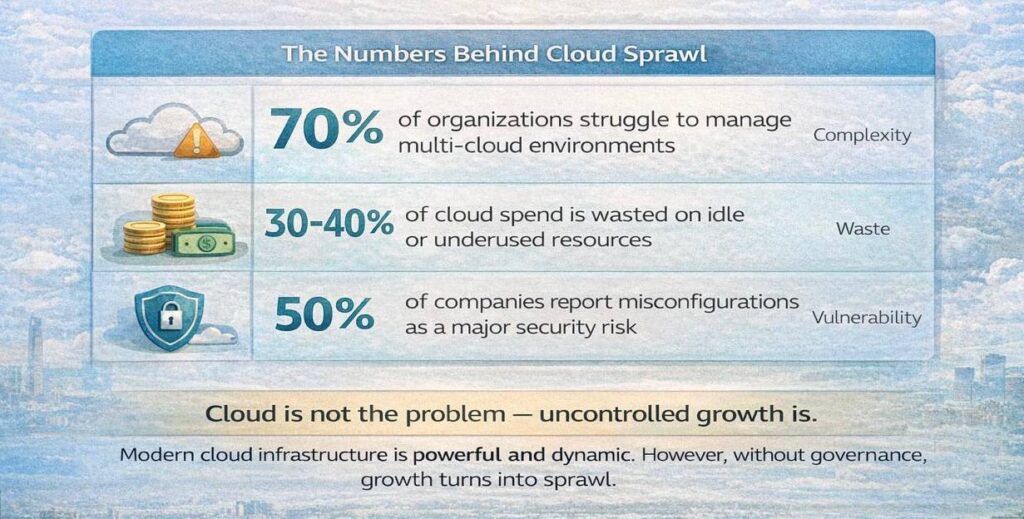
More than 70% of organizations report difficulty managing multi-cloud environments, highlighting the complexity of modern infrastructure.
At the same time, up to 30–40% of cloud spending is wasted on unused or underutilized resources. Visibility remains a challenge.
Over 60% of companies lack full visibility into their cloud environments, making it difficult to optimize and secure systems.
Security risks are also increasing. Nearly 50% of organizations identify misconfigured cloud resources as a major vulnerability.
These numbers reveal a clear pattern: cloud is not the problem — uncontrolled growth is.
Why It Gets Out of Control
Cloud sprawl often goes unnoticed. Resources are created incrementally, making growth difficult to track.
There is also a lack of ownership. When multiple teams manage infrastructure, responsibility becomes unclear.
Another issue is delayed optimization. Companies focus on building and scaling first, postponing cost and resource management.
Over time, this creates accumulation. What starts as flexibility becomes fragmentation.
How to Control Cloud Sprawl
Managing cloud sprawl requires structure. The first step is visibility. Organizations must understand what resources exist, who owns them, and how they are used.
Governance is critical. Policies, standards, and access controls help prevent uncontrolled growth.
Cost management must be continuous. Monitoring usage, optimizing resources, and eliminating waste are essential.
Automation plays a key role. Automated provisioning, scaling, and cleanup reduce manual effort and improve consistency.
Finally, ownership must be defined. Each resource should have clear responsibility to ensure accountability.
From Infrastructure to Platform Thinking
Leading organizations treat cloud as a platform, not just infrastructure. They standardize environments, automate workflows, and centralize governance. This reduces complexity while maintaining flexibility.
The goal is not to limit growth — but to control it.
Conclusion
Cloud sprawl is one of the most underestimated challenges in modern infrastructure.
In 2026, the organizations that succeed are not those using the most cloud services — but those managing them effectively. Cloud should enable growth — not limit it.
Why Ficus Technologies
Ficus Technologies helps businesses design and manage cloud environments that are scalable, controlled, and optimized for performance and cost.
Uncontrolled growth of cloud resources across systems and teams.
It increases cost, complexity, and security risks.
Lack of governance, visibility, and ownership.
Through governance, automation, and continuous optimization.






 Success...!