
AI is no longer an experimental layer in digital products. In 2026, it is becoming a core capability that directly impacts growth, retention, and operational efficiency.
Companies are shifting from asking “Should we use AI?” to “Where does AI create measurable value in our product?”
The challenge is not adoption — it is integration. Many teams add isolated AI features that do not scale, do not integrate with workflows, and do not deliver business impact.
Successful products treat AI as part of the roadmap, not as an add-on.
CTOs and tech leaders integrating AI into platforms.
Data and AI teams building production systems.
Companies scaling digital products with data.
- AI must be embedded into product strategy, not added as a feature.
- Value comes from solving specific problems, not from using AI for its own sake.
- Data, infrastructure, and product design must evolve together.
Why Most AI Initiatives Fail in Products
The biggest mistake teams make is treating AI as a feature.
They build chatbots, recommendation engines, or predictive models without integrating them into the core product flow. As a result, these features remain underused or fail to deliver measurable value.
AI does not work as a standalone capability. It depends on data pipelines, feedback loops, and continuous iteration.
Another issue is lack of clear use cases. Teams often implement AI because it is trending, not because it solves a real problem.
Without a direct link to business metrics — such as conversion, retention, or cost reduction — AI initiatives fail to justify their investment.
In 2026, the difference between successful and failed AI products is simple: successful teams build AI around outcomes, not technology.
Where AI Creates Real Product Value
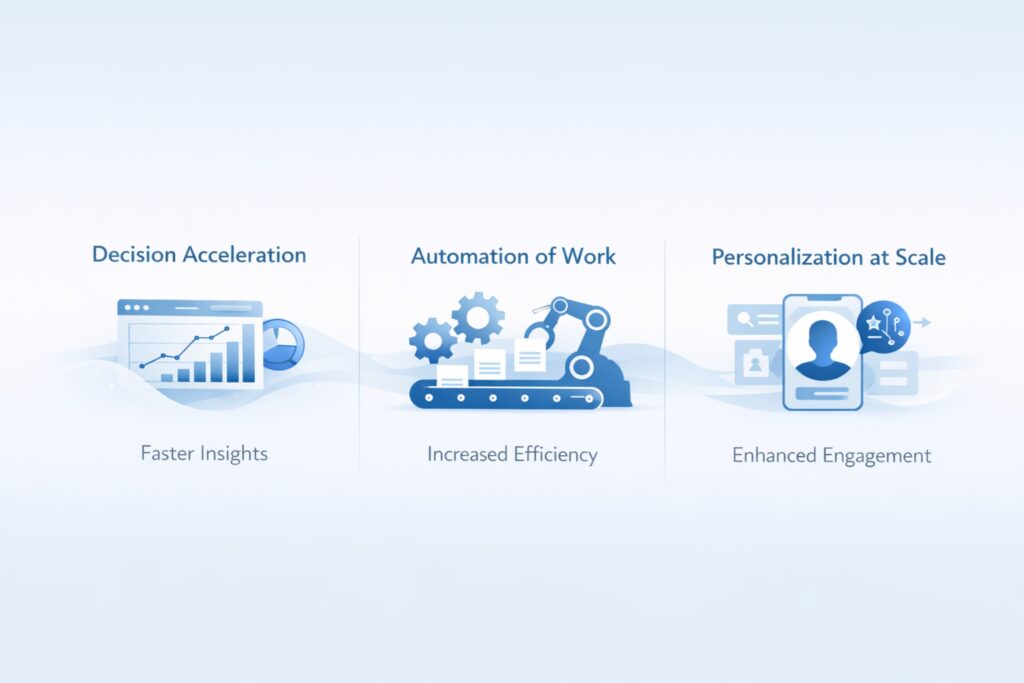
AI delivers value when it improves decisions, reduces friction, or automates complexity.
In practice, this happens in three key areas:
- Decision Acceleration –
AI processes large volumes of data and generates insights faster than human analysis. This improves pricing, recommendations, and operational decisions. - Automation of Repetitive Work –
AI reduces manual tasks such as support handling, data processing, and workflow management. This directly impacts cost and efficiency. - Personalization at Scale –
AI adapts product experiences based on user behavior. This improves engagement, retention, and customer satisfaction.
Products that succeed with AI focus on these areas instead of building isolated “AI features.”
AI in Product Strategy (2026)
AI is now directly tied to product performance. More than 80% of digital products launched in 2026 include AI-driven functionality as a core component.
Products using AI-driven personalization report 20–30% higher user engagement and retention rates compared to traditional approaches.
AI-powered automation reduces operational workload by up to 40%, especially in customer support and data processing.
At the same time, over 50% of AI initiatives fail to reach production scale, primarily due to poor integration with product workflows and lack of data readiness.
Organizations that successfully integrate AI into their roadmap are 2–3x more likely to improve decision speed and product efficiency.
The key takeaway: AI impact is real — but only when it is embedded into the product, not layered on top.
How to Build AI into a Product Roadmap
Integrating AI into a product roadmap requires a fundamental shift in how products are planned, built, and scaled. AI cannot be treated as a feature that is added at a specific stage — it must be embedded into the product’s logic, workflows, and decision-making processes.
The starting point is not technology, but business outcomes. AI should be tied directly to measurable impact. This means identifying where it can improve revenue, reduce operational costs, increase user engagement, or optimize internal processes. Without this connection, AI becomes an isolated experiment rather than a driver of product value.
Once the outcomes are defined, AI must be integrated into real product workflows. Successful implementations do not introduce AI as a separate layer. Instead, they embed it into existing user journeys — recommendations within user flows, automation within operations, predictions within decision points. The goal is to make AI invisible but impactful. Data readiness is a critical dependency.
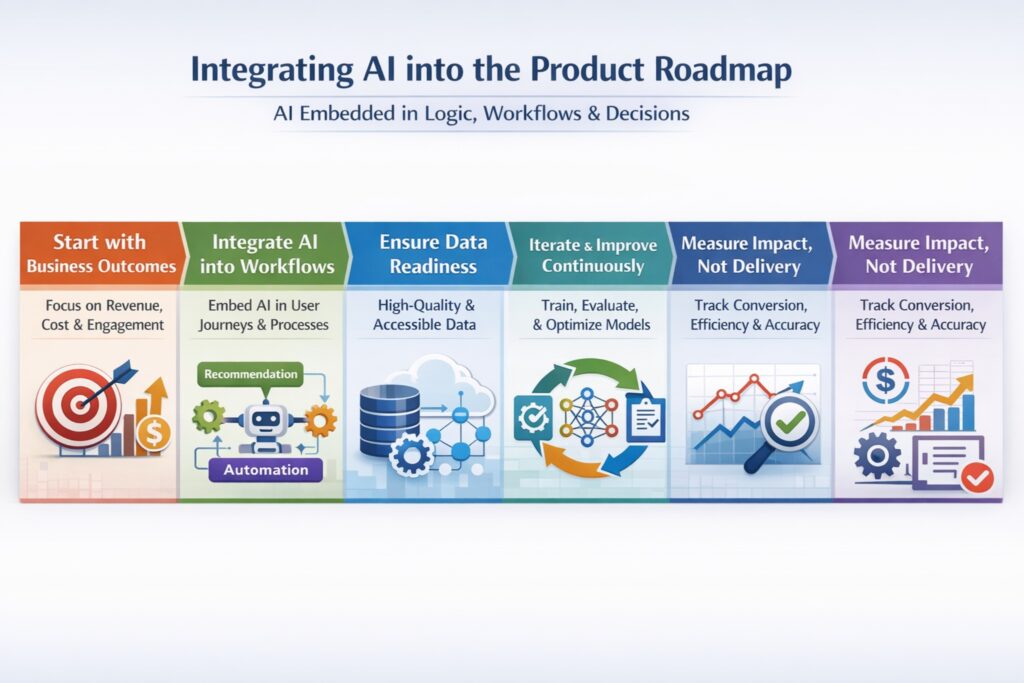
AI systems rely on structured, high-quality, and continuously updated data. Many initiatives fail because data is fragmented across systems, inconsistent, or not accessible in real time. Before scaling AI, organizations must ensure that data pipelines, storage, and processing are reliable and aligned with product needs.
Another key difference between traditional features and AI capabilities is iteration. AI is not launched — it is trained, evaluated, and continuously improved. Product roadmaps must reflect this by including cycles for model updates, feedback collection, and performance optimization. Static planning does not work for dynamic systems.
Measurement also changes. Instead of tracking feature delivery, teams must track impact. This includes improvements in conversion rates, engagement, operational efficiency, or decision accuracy. AI must prove its value through measurable outcomes, not technical complexity.
Architecture Matters More Than Features
AI integration is not only a product challenge — it is primarily an architectural one. Without the right foundation, even well-designed AI features cannot scale or deliver consistent results. Modern AI-driven products require infrastructure that supports real-time data processing, model deployment, and continuous learning.
This includes systems capable of handling streaming data, pipelines that ensure data consistency, and environments where models can be deployed, monitored, and updated without disrupting the product.
Equally important are feedback loops. AI systems improve based on new data, and products must be designed to capture user interactions and feed them back into the system. Without this loop, models degrade over time.
Scalability is another critical factor. As usage grows, both data volume and model complexity increase. Infrastructure must support this growth without affecting performance.
Without this architectural layer, AI remains a prototype — technically functional, but not reliable or scalable in production. Modern AI products are not built as collections of features. They are built as systems where data, models, and product logic operate together.

Align AI, data, and architecture to drive real business outcomes.
Contact usAI, UX, and Trust
AI directly shapes user experience, and its success depends on how users perceive and trust it.
When AI influences decisions — recommendations, pricing, approvals, or content — users expect those decisions to be consistent and understandable. If outcomes feel random or unexplained, trust breaks down quickly.
Transparency is essential. Users should understand when AI is being used and what it is doing. This does not require exposing technical details, but it does require clarity in how outcomes are presented.
Control is equally important. In many cases, users need the ability to adjust, override, or influence AI-driven decisions. This creates a sense of reliability and reduces resistance to automation.
Poorly implemented AI creates friction. Well-designed AI feels natural and predictable. Trust becomes a key success factor. Even the most advanced models will fail if users do not trust their outputs. Products that succeed with AI are those that combine intelligence with clarity, consistency, and user control.
In 2026, building AI into products is not just about capability — it is about designing systems that users are willing to rely on.
Conclusion
AI is not a feature — it is a capability that reshapes how products are built and how they deliver value.
The companies that succeed are those that integrate AI into their roadmap at every level: product strategy, data infrastructure, and user experience. In 2026, competitive products are not just digital — they are intelligent.
Why Ficus Technologies?
Ficus Technologies helps companies integrate AI into product roadmaps by aligning data, architecture, and product strategy.
We focus on building scalable AI systems that deliver measurable business impact — not just experimental features.
Because they are not integrated into core workflows or tied to business outcomes.
Where it improves decisions, automates processes, or enhances user experience.
AI should be treated as a system integrated into the product.






 Success...!