For years, enterprise identity security was designed primarily around people. Employees received accounts, passwords, roles, permissions, and access reviews. When someone joined a company, access was created; when responsibilities changed, permissions were adjusted; when the employee left, the account was disabled.
Modern infrastructure no longer works this way. Applications authenticate to databases, APIs communicate with other APIs, CI/CD pipelines deploy software, containers access cloud resources, bots automate workflows, SaaS platforms exchange information, and AI agents increasingly use tools and perform actions without direct human involvement at every step. All of these systems need identities. These non-human identities (NHIs) can be represented by service accounts, API keys, certificates, OAuth tokens, cloud workload identities, secrets, SSH keys, and other credentials. Their purpose is similar to a human identity: prove which entity is requesting access and determine what that entity is allowed to do. The difference is scale and behavior. CyberArk reported that machine identities can outnumber human identities by approximately 82 to 1, while 50% of surveyed security leaders said their organizations had experienced security incidents or breaches involving compromised machine identities.
As automation and AI adoption accelerate, identity security is therefore moving beyond the traditional question of who has access. Businesses increasingly need to understand which machines have access, who controls them, what permissions they hold, and what actions they can perform.
- Non-human identities already outnumber human accounts in many modern environments.
- APIs, workloads, pipelines, bots, integrations, and AI agents all create identity risk.
- Long-lived secrets, excessive permissions, identity reuse, and poor offboarding are major weaknesses.
Identity Is No Longer Human-Centric
The modern enterprise identity environment includes far more than employee accounts.
A service accessing a database needs an identity. A Kubernetes workload retrieving information from cloud storage needs an identity. A CI/CD pipeline deploying an application needs an identity. A CRM integration communicating with a marketing platform needs an identity. An AI agent using email, customer records, or internal tools also needs an identity. The credential behind that identity can take many forms.
The number of these identities grows naturally as architecture becomes more distributed.
A traditional application might require several technical accounts. A microservices environment may contain hundreds of services, each communicating with databases, queues, APIs, storage systems, observability platforms, and other services. Cloud-native infrastructure adds temporary containers, serverless functions, orchestration systems, and infrastructure automation. This means an organization with several thousand employees may be operating tens or hundreds of thousands of machine identities. CyberArk’s research illustrates the imbalance. Machine identities were reported to outnumber human identities by roughly 82:1, reflecting the expansion of cloud infrastructure, automation, APIs, and AI. The problem is not simply that businesses have more identities to manage. Machine identities behave differently. They may operate continuously, authenticate thousands of times per day, appear and disappear automatically, hold privileges for years, and access systems without a human entering credentials. Traditional controls such as annual access reviews or employee offboarding workflows were not designed for this level of speed and scale. Identity security therefore needs to treat applications, workloads, services, devices, and agents as first-class identities rather than invisible technical components.
Long-Lived Credentials and Excessive Access Create Persistent Risk
Many non-human identities still authenticate using permanent or long-lived credentials.
An API key might remain valid for several years. A database password may be embedded in application configuration. A cloud access key may be stored inside a CI/CD platform. A private key may exist in a container image or internal repository. These approaches are convenient because almost every system supports them. But convenience creates persistence. A password belonging to an employee can usually be reset without redesigning an application. Rotating a machine credential can be much more difficult if that credential has been copied across applications, scripts, environments, documentation, and integrations.
As a result, teams often avoid changing credentials because they are afraid of breaking production.
The longer a secret remains active, the greater the opportunity for it to leak through source repositories, logs, configuration files, chat conversations, developer machines, backups, or compromised third-party systems.
Once attackers obtain a legitimate machine credential, they may not need to exploit the application at all. They can simply authenticate as a trusted identity. The problem becomes significantly worse when that identity has excessive permissions. A deployment pipeline may need permission to update one application but receive administrative access to an entire cloud environment. A service that only needs to read a specific database table may receive broad database privileges. A SaaS integration may request far more access than its actual workflow requires. These permissions often begin as development shortcuts. The application works, the deployment succeeds, and the access remains. Over time, organizations accumulate machine identities whose actual privileges are much broader than their intended function. Another problem is identity reuse.
Teams sometimes use the same API key or service account across multiple applications because it simplifies configuration. Development, staging, and production environments may even share credentials.
This increases blast radius dramatically. If one application is compromised, the attacker may gain access to every environment or workload using the same identity. Security teams also lose visibility because activity from several systems appears under one account. Every important workload should therefore have a unique identity and permissions aligned with its actual role. Long-lived credentials, excessive privileges, and reused identities are different problems, but they create the same underlying weakness: a compromised machine identity can provide attackers with legitimate, persistent access to systems the organization already trusts.
AI Agents Change the Security Model
AI agents make non-human identity security considerably more important because they combine access with autonomy. Traditional machine identities usually execute predefined code. A deployment pipeline follows a specific sequence. A background service processes a known task. An integration moves information between defined systems. AI agents can behave differently. An agent may analyze information, decide which tool to use, call APIs, retrieve data, perform several actions, communicate with other systems, and adapt its workflow based on the situation. This means the identity is no longer attached only to predictable automation.
It may belong to a system capable of deciding how to use its permissions. Consider an AI customer-service agent with access to CRM records, order information, email, refund tools, and internal documentation. The identity may legitimately need several permissions to complete customer requests.
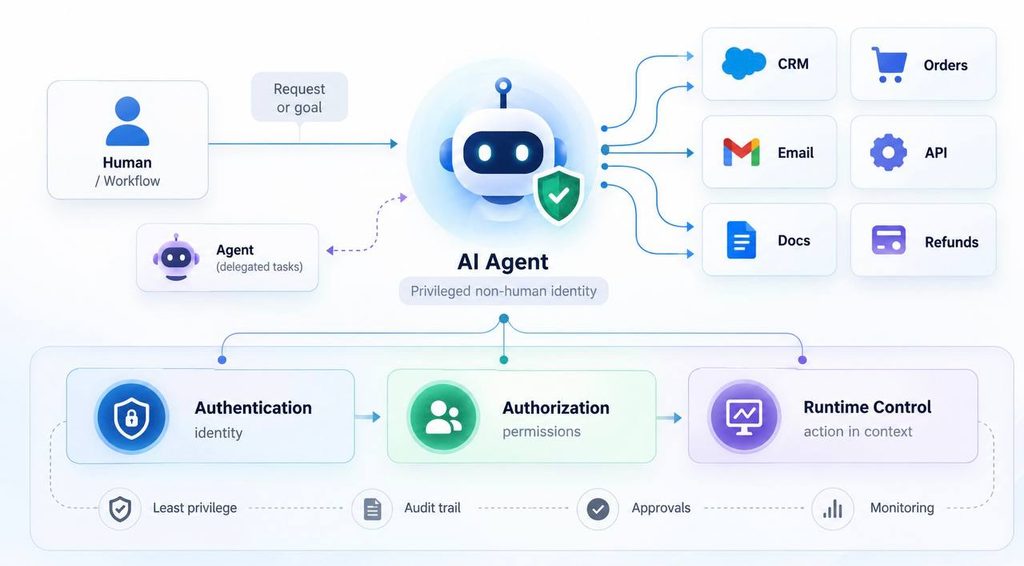
But those permissions also create a powerful execution environment. If the agent receives malicious instructions, incorrectly interprets information, or is manipulated through another connected system, the security question is no longer simply whether the agent was authenticated correctly.The agent may be completely legitimate. The problem is whether the action it decided to perform was appropriate.
That creates three different layers of control:
- Authentication determines which agent or workload is making the request.
- Authorization determines which resources and actions that identity is permitted to access.
- Runtime control determines whether a particular action should be allowed in the current context.
This distinction becomes especially important as agents gain the ability to modify customer records, send communications, create transactions, deploy software, access internal documents, or trigger other automated workflows. AI agents should therefore increasingly be treated as privileged non-human identities.
Their access should be tied to clearly defined capabilities rather than broad application permissions. High-impact actions may require additional approval. Credentials should be scoped to specific tools and tasks. Activity should be attributable to both the agent and, where appropriate, the human or workflow that initiated it.
Agent-to-agent communication adds another layer of complexity. One agent may delegate work to another agent, which then calls an API or triggers a third automated process. Authority begins moving through chains of software identities. Without strong identity and authorization boundaries, businesses can create environments where machines continuously delegate capabilities without clear visibility into where the original authority came from. As agentic systems become more common, securing AI will therefore increasingly depend on solving the same questions businesses are already facing with non-human identities: identity, ownership, privilege, lifecycle, and accountability.
Visibility and Ownership Come Before Control
Organizations cannot secure machine identities they do not know exist. This is one of the largest differences between human and non-human identity management. Employees usually enter through centralized HR and IAM processes. Machine identities can be created almost anywhere. A developer creates an API key. A cloud platform creates a service account. Kubernetes generates workload identities. A CI/CD tool creates access tokens. A SaaS integration receives OAuth permissions. A certificate is issued by another infrastructure team. An AI platform creates an agent connected to several enterprise tools. Each individual decision can be legitimate. Collectively, they create an identity estate that no single team fully understands. Security programs therefore need continuous discovery rather than relying only on manually maintained lists.
Organizations should be able to identify service accounts, API keys, certificates, SSH keys, OAuth applications, cloud workload identities, CI/CD credentials, integrations, automation bots, and AI agents.
But inventory alone does not solve the problem. Finding 50,000 non-human identities without understanding their context simply produces a larger spreadsheet. For every important identity, security teams need to answer practical questions: Which workload uses it? Which team owns it? What resources can it access? What permissions does it hold? When was it last used? Is the associated application still active? Where are its credentials stored? What would happen if the identity were disabled? Ownership is particularly important.
Every production NHI should have a responsible owner, even if that owner is an engineering team rather than a specific individual. Without ownership, unused identities survive because nobody wants to risk disabling them. A common scenario is a security team discovering an old service account with powerful permissions. The account has not been used recently, but documentation is missing and nobody knows which system originally created it. Removing it might be safe. Or it might break an important legacy application. The uncertainty itself becomes a security problem.
Security Needs to Move From Permanent Secrets to Dynamic Identity
One of the most important architectural changes businesses can make is reducing dependence on permanent machine credentials. Traditional application authentication often follows a simple model: generate a password, API key, or private key, store it somewhere, and let the application use it whenever access is required.
Modern workload identity offers a different model. Instead of proving identity with a permanent secret stored inside the application, the workload can establish who it is dynamically based on trusted infrastructure. The system can then issue temporary credentials or tokens for the specific resource the workload needs. This changes the security properties significantly. A permanent cloud access key leaked from a repository might remain useful until somebody discovers the incident and manually revokes it. A short-lived token that expires after minutes provides attackers with a much smaller opportunity. The same principle can apply to containers, serverless functions, CI/CD pipelines, internal services, and eventually AI agents.
Credentials should increasingly become temporary results of identity verification rather than permanent objects applications need to store. This also changes least privilege. Traditional least privilege asks whether an identity has only the permissions necessary to perform its role. Modern systems increasingly need to ask whether the identity needs those permissions right now. A CI/CD pipeline may need privileged infrastructure access only during deployment. An AI agent may need permission to update a customer account only while processing an approved customer request. Keeping those privileges permanently available increases risk without creating additional business value. Just-in-time authorization allows systems to grant access when a legitimate workflow requires it and remove it afterward. This model does not eliminate identity attacks, but it significantly reduces persistent exposure. It also makes infrastructure more compatible with modern dynamic environments where workloads may exist for only minutes or seconds. The long-term shift is therefore from secret-based machine access toward identity-based, temporary, contextual authorization.
Make non-human identities visible, controlled, and secure — with Ficus Technologies.
Contact usNon-Human Identity Security Needs to Become an Operating Model
Securing non-human identities cannot be solved through one security product. The problem crosses IAM, cloud infrastructure, application development, DevOps, API management, secrets management, PKI, SaaS governance, and AI security. Organizations therefore need an operating model that manages machine identities throughout their lifecycle. The foundation is discovery. Businesses need visibility into which identities exist and where they are being used. The next layer is ownership. Every important identity needs a responsible team and a clear business purpose. Permissions then need to be aligned with actual workload behavior. Service accounts should not automatically receive administrative access simply because broad permissions are easier to configure. Credentials should be short-lived wherever architecture allows it, while permanent secrets need automated rotation and secure storage. Monitoring also needs to become machine-aware. Human identity systems often detect unusual devices, login locations, working hours, or travel patterns. Those signals are not particularly useful for a cloud workload operating continuously.
Machine behavior needs different baselines. A service that normally reads one database but suddenly requests administrative privileges is suspicious. A deployment identity that begins downloading customer information requires investigation. An AI agent that normally searches support tickets but suddenly attempts to export large amounts of internal data represents a behavioral change worth examining.
Lifecycle automation is equally important. An identity should be created when the workload is created, modified when its requirements change, and removed when the workload disappears. At large scale, manual administration cannot keep up. The objective is not to make developers request security approval every time they deploy a service. That approach would create friction and encourage workarounds. Instead, secure identity patterns should become part of the platform. Developers should be able to create a workload and automatically receive a unique identity, scoped permissions, short-lived authentication, centralized logging, and lifecycle management without manually designing those controls every time. That is ultimately where non-human identity security needs to move. The safest machine identity is not one that requires constant security-team intervention. It is one whose secure behavior is built into the infrastructure by default.
Conclusion
Enterprise identity is no longer primarily a human problem. APIs, cloud workloads, microservices, CI/CD pipelines, automation bots, certificates, SaaS integrations, connected devices, and AI agents are creating a rapidly expanding population of non-human identities. Many of these identities operate continuously, hold sensitive privileges, and exist outside traditional IAM processes. The risk grows when credentials are long-lived, permissions are excessive, identities are reused, ownership is unclear, and unused accounts remain active long after the workload disappears. AI agents raise the stakes further because identity is becoming connected to autonomous action. Businesses therefore need to expand identity security beyond employee accounts and passwords. Every important machine identity should be discoverable, uniquely attributable, owned, minimally privileged, temporary where possible, continuously monitored, and automatically retired when its purpose ends.
The future security question is no longer only: Who has access?
Why Ficus Technologies?
At Ficus Technologies, we help businesses design and modernize digital environments where security is built into the architecture from the beginning. Modern identity challenges extend across APIs, cloud infrastructure, microservices, CI/CD pipelines, automation, integrations, and AI systems. Addressing them requires more than configuring an IAM platform. It requires understanding how applications authenticate, how permissions move between systems, how credentials are stored, and how identities behave throughout their lifecycle.
Our expertise across custom software development, cloud architecture, DevOps, API integration, cybersecurity, AI implementation, and infrastructure modernization helps businesses build stronger service-to-service authentication, reduce unnecessary credential exposure, improve access boundaries, and introduce scalable security controls for increasingly automated environments.
Build secure digital systems for a world where identities are increasingly non-human — with Ficus Technologies.
A non-human identity represents software rather than a person, such as an application, API, workload, service account, device, bot, integration, or AI agent.
Their number is growing quickly, and many rely on long-lived credentials, excessive permissions, weak ownership, or incomplete lifecycle management.
Yes. Agents that access enterprise tools, data, APIs, or applications require identities and permissions and should be governed accordingly.
Start with discovery and ownership, use unique identities, enforce least privilege, reduce long-lived secrets, introduce short-lived credentials, monitor behavior, and automate offboarding.
No. Secrets management is important, but NHI security also requires identity discovery, ownership, permissions, lifecycle management, monitoring, and authorization.
The industry is moving from permanent stored credentials toward dynamic workload identities, temporary authorization, and security controls built directly into cloud and development platforms.





 Success...!