
For more than two decades, Software-as-a-Service has been the dominant model for delivering digital products. Organizations adopted SaaS because it reduced infrastructure costs, simplified deployment, and made software accessible through the browser. Entire business ecosystems were built around specialized applications designed to solve specific operational problems.
By 2026, however, a new discussion is emerging. Advances in generative AI, large language models, and autonomous agents have raised questions about whether traditional software interfaces remain the most effective way for people to interact with digital systems.
The debate is often framed as a competition between AI agents and SaaS platforms. Yet the reality is more nuanced. The question is not whether AI will replace software entirely, but how software itself may evolve when intelligence becomes a built-in capability rather than a separate tool.
For business leaders, the challenge is understanding which elements of the traditional software model remain valuable and which are likely to change over the coming years.
Technology and transformation teams exploring AI agents, intelligent automation, and modern software architecture.
Organizations investing in AI capabilities to improve customer experiences, operational efficiency, and business innovation.
- AI agents are unlikely to eliminate SaaS platforms, but they are changing how users interact with software.
- What works in 2026 is combining AI-driven interfaces with reliable platforms, structured data, and well-defined business processes.
- What loses relevance is the assumption that users will continue navigating dozens of separate applications to complete routine work.
Why SaaS Became the Default Model
SaaS succeeded because it solved a practical problem. Organizations needed software that could be deployed quickly, updated continuously, and accessed from anywhere.
The model standardized how businesses consume technology. Companies purchased applications for CRM, finance, collaboration, analytics, and operations. Users learned interfaces, workflows, and navigation patterns designed around individual products.
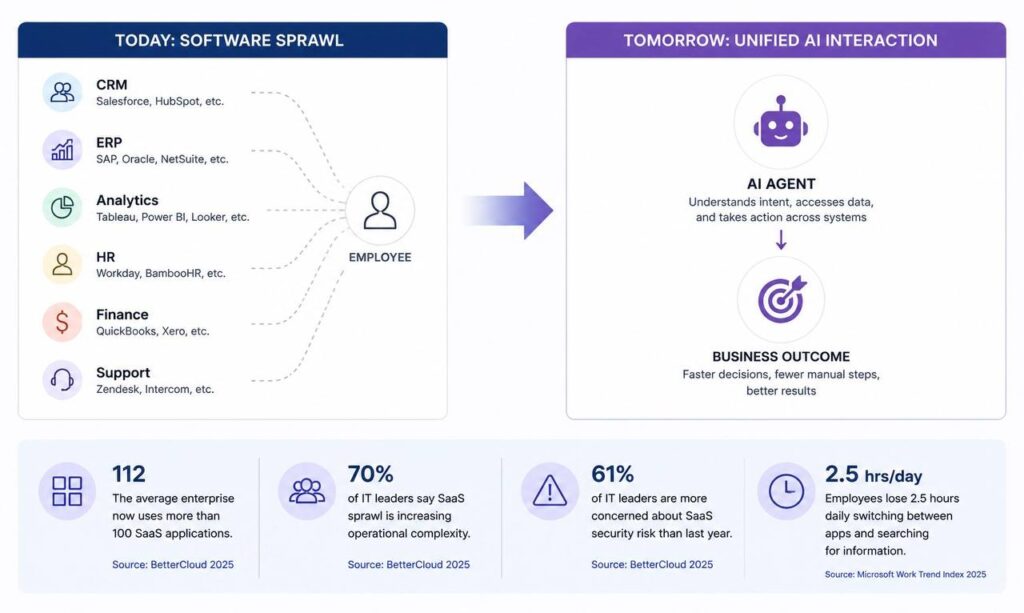
This approach proved highly scalable. Yet it also created complexity. As organizations adopted more applications, employees spent increasing amounts of time switching between systems, managing integrations, and navigating fragmented workflows.
The success of SaaS created the conditions that AI agents are now attempting to simplify.
AI Agents Change the Interface Layer
Unlike traditional software, AI agents are not primarily defined by screens, menus, or forms. Their value comes from interpreting intent and executing actions across systems.
Rather than opening multiple applications to complete a task, users increasingly interact with a single conversational interface capable of accessing information, triggering workflows, and coordinating actions across platforms.
The shift is significant because it changes where complexity exists. Instead of requiring users to learn software, software increasingly adapts to user intent.
This does not eliminate the need for underlying systems. It changes how people access them.
Software Consumption Is Already Changing
The growing interest in AI agents reflects a broader trend toward reducing operational friction.
Research from Microsoft’s Work Trend Index and other industry studies consistently shows that employees spend substantial time searching for information, switching contexts, and navigating disconnected tools. As organizations adopt more applications, digital complexity often increases faster than productivity.
At the same time, enterprise investment in generative AI continues to accelerate. Organizations are increasingly experimenting with agent-based workflows capable of retrieving information, coordinating actions, and supporting decision-making across multiple systems.
These developments suggest that businesses are not necessarily seeking more software. They are seeking simpler ways to interact with the software they already have.
Software Sprawl Is Creating Demand for AI Agents
The case for AI agents starts with the limits of the current SaaS model. According to BetterCloud’s 2025 State of SaaS Report, IT teams are still dealing with SaaS sprawl, rising operational complexity, security concerns, and pressure to automate SaaS management.
At the same time, Microsoft’s 2025 Work Trend Index analyzed data from 31,000 workers across 31 countries and points to growing strain in knowledge work as business demands increase faster than human capacity.
This is why AI agents are gaining attention. The issue is not that companies lack software. The issue is that employees increasingly need a simpler way to move across software, data, and workflows without manually navigating every application.
Why SaaS Is Not Disappearing
Predictions about the end of SaaS often overlook an important reality. AI agents require systems to operate on.
Business logic, compliance controls, transactional data, permissions, and operational processes still need structured platforms underneath the interface layer.
An AI agent may help a sales manager update forecasts, but the underlying CRM remains essential. An agent may simplify expense approvals, but financial systems continue to manage records, governance, and reporting requirements.
In practice, SaaS platforms increasingly become infrastructure for AI-driven experiences rather than standalone destinations for users.
The software does not disappear. It becomes less visible.
The Rise of Agent-Enabled Platforms
Many organizations are already moving toward hybrid models where AI agents operate on top of existing platforms.
This approach combines the strengths of both worlds. SaaS provides reliability, governance, and operational structure. AI agents provide flexibility, personalization, and automation.
Rather than replacing software, agents become an intelligent orchestration layer capable of connecting systems and reducing workflow complexity.
For enterprise environments, this model is often more realistic than a complete replacement of existing platforms.
The Market Is Moving Toward Intelligent Interfaces
Industry forecasts suggest that agentic AI will become a major area of enterprise investment over the next several years. Technology vendors increasingly position AI agents as a new interface layer capable of coordinating activity across applications.
At the same time, software vendors are embedding AI directly into their products rather than treating it as a separate capability. CRM platforms, ERP systems, collaboration tools, and analytics environments are all evolving toward more autonomous experiences.
This convergence indicates that the future is unlikely to be AI agents versus SaaS. Instead, it is likely to be SaaS platforms enhanced and orchestrated by AI.
Enterprise Software Is Moving Toward Agentic AI
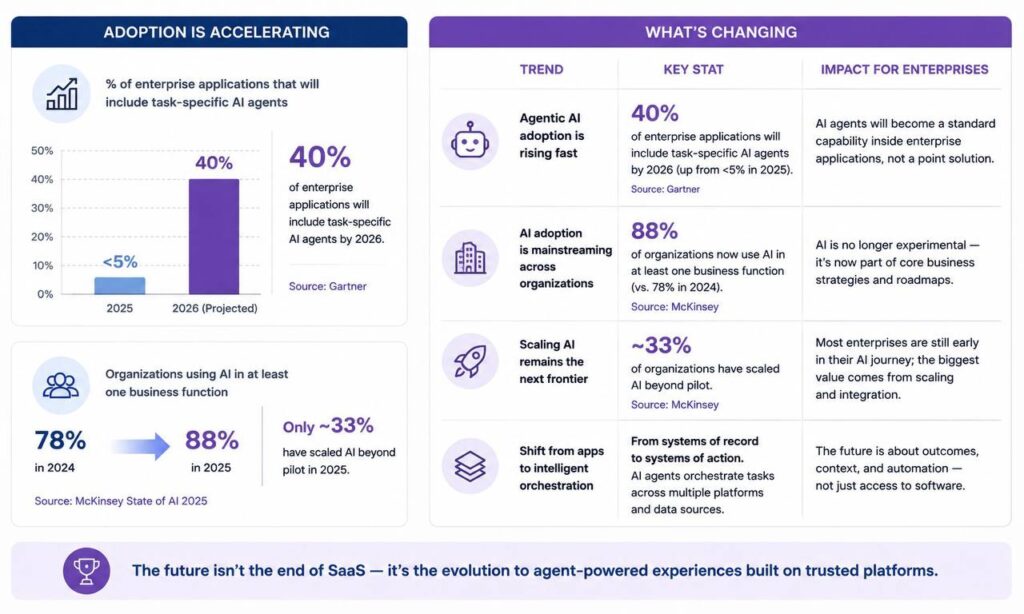
The shift is already visible in enterprise software strategy. Gartner predicts that 40% of enterprise applications will include task-specific AI agents by the end of 2026, up from less than 5% in 2025.
McKinsey’s 2025 State of AI report also shows that 88% of organizations now use AI in at least one business function, compared with 78% a year earlier, but only about one-third have started scaling AI programs beyond pilots.
These numbers show the real direction of the market. SaaS is not disappearing, but enterprise software is becoming more agent-driven. The next shift is not from software to no software. It is from application-centered workflows to AI-assisted orchestration across platforms.
What Loses Relevance in 2026
Several assumptions about enterprise software continue to weaken.
The idea that every business process requires a dedicated user interface becomes less compelling as AI agents mature. Manual navigation across dozens of applications introduces friction that organizations increasingly seek to eliminate.
Similarly, software strategies focused solely on feature expansion become less effective. Users increasingly value simplicity, automation, and outcome-based interactions over additional functionality.
The future of software is becoming less about access to tools and more about access to results.
Conclusion
The debate between AI agents and SaaS often frames the future as a choice between two competing models. In reality, the relationship is more complementary than competitive.
AI agents are transforming how people interact with software, but they still depend on the platforms, data structures, and operational systems that SaaS products provide.
The organizations that benefit most from this shift will not be those that abandon existing software investments. They will be the ones that successfully combine intelligent interfaces with scalable platforms and well-designed architectures.
The future of enterprise technology is unlikely to be software without AI or AI without software. It will be the convergence of both.

Exploring how AI agents fit into your software strategy?
Contact usWhy Ficus Technologies?
Ficus Technologies helps organizations design scalable digital platforms that integrate AI capabilities without sacrificing governance, reliability, or operational control.
As AI agents become part of enterprise workflows, businesses need architectures capable of connecting intelligent interfaces with existing systems, data models, and business processes.
Ficus focuses on building cloud-native platforms that support automation, interoperability, and long-term scalability, helping organizations adapt to the next generation of software experiences.
Most likely not. AI agents are expected to change how users interact with software, while SaaS platforms continue providing business logic, data management, and operational infrastructure.
Because they reduce the need to navigate multiple applications and can coordinate actions across systems through a single interface.
SaaS platforms will increasingly function as the operational foundation that AI agents access and orchestrate.
Most organizations benefit more from integrating AI capabilities into existing platforms than from attempting complete replacement.
The movement from application-centric workflows toward intent-driven interactions where users focus on outcomes rather than software navigation.




 Success...!