AI agents are changing the security model of enterprise software.Traditional applications usually wait for a person to perform an action. A user signs in, opens a screen, selects an option, and sends a request. Access controls can therefore be designed around relatively predictable interactions between a human identity and an application. AI agents can operate differently. An agent may receive a goal, analyze information, search internal data, call APIs, choose tools, communicate with other agents, update records, send messages, create files, trigger workflows, or take actions across several systems before returning a result. That capability is what makes agentic AI valuable. It is also what makes it dangerous when access is too broad. The central security question is no longer simply whether an AI model can generate unsafe content. Businesses increasingly need to ask what the agent can reach, which actions it can perform, whose authority it is using, and what happens if its reasoning is manipulated.
OWASP’s Top 10 for Agentic Applications for 2026 reflects this shift. Its risk framework includes agent goal hijacking, tool misuse, identity and privilege abuse, memory poisoning, insecure inter-agent communication, cascading failures, and other risks that emerge specifically when AI can take actions rather than only produce text. Securing autonomous agents therefore requires more than traditional application security or prompt filtering. It requires a new access architecture built around identity, least privilege, tool boundaries, contextual authorization, runtime monitoring, and controlled autonomy.
- AI agents need their own identities and should not inherit unlimited user access.
- Tool access should be explicitly allowed rather than implicitly available.
- Least privilege needs to apply to both resources and individual actions.
Autonomous Agents Turn Access Into an Execution Problem
The security model changes when AI moves from generating information to taking action. A chatbot that answers questions may access documentation and return text. The potential damage from an incorrect response can still be serious, but its direct ability to change external systems may be limited. An autonomous agent can have a much larger operating surface. A customer-support agent might read CRM records, search order history, check inventory, issue a refund, update a ticket, and send an email. A software engineering agent may inspect repositories, modify code, open pull requests, run development tools, or trigger CI/CD workflows. A finance agent could retrieve invoices, reconcile records, prepare payments, or interact with accounting platforms. Each additional capability increases the usefulness of the agent. It also expands the consequences of a mistake or compromise. The crucial difference is that an agent may decide when and how to use those capabilities.
Traditional automation follows a predefined sequence. If an application is programmed to retrieve order information and display it, its execution path is relatively narrow. An AI agent can interpret a goal, create intermediate steps, select between tools, and alter its behavior based on information received during the task. This creates a new kind of attack surface. An attacker may not need to compromise the underlying model directly. They may instead influence the information the agent sees. A malicious instruction hidden inside a document, email, website, API response, or retrieved dataset can attempt to alter the agent’s behavior. OWASP identifies direct and indirect prompt injection, goal hijacking, tool abuse, data exfiltration, memory poisoning, and excessive autonomy among the important risks facing AI agents. If the agent has no meaningful permissions, manipulation has limited impact. If the same agent can access sensitive databases, send external messages, change permissions, or execute transactions, the consequences are very different. This is why AI agent security needs to start with access architecture rather than relying entirely on improving model behavior. A model can be manipulated. The surrounding system should still prevent that manipulation from becoming an unauthorized business action.
Every Agent Needs a Clear Identity and Limited Authority
One of the most important design decisions is giving every production agent a distinct identity. An agent should not simply operate using a shared administrative account or automatically inherit all of the permissions belonging to the human who initiated the task. Microsoft’s current guidance for agent security emphasizes that users, agents, plugins, workloads, and tools should have verified identities, explicit authorization, and only the minimum rights they require. It also recommends binding permissions to the initiating principal and specific task while keeping authorization as short-lived as practical. This separation creates accountability.
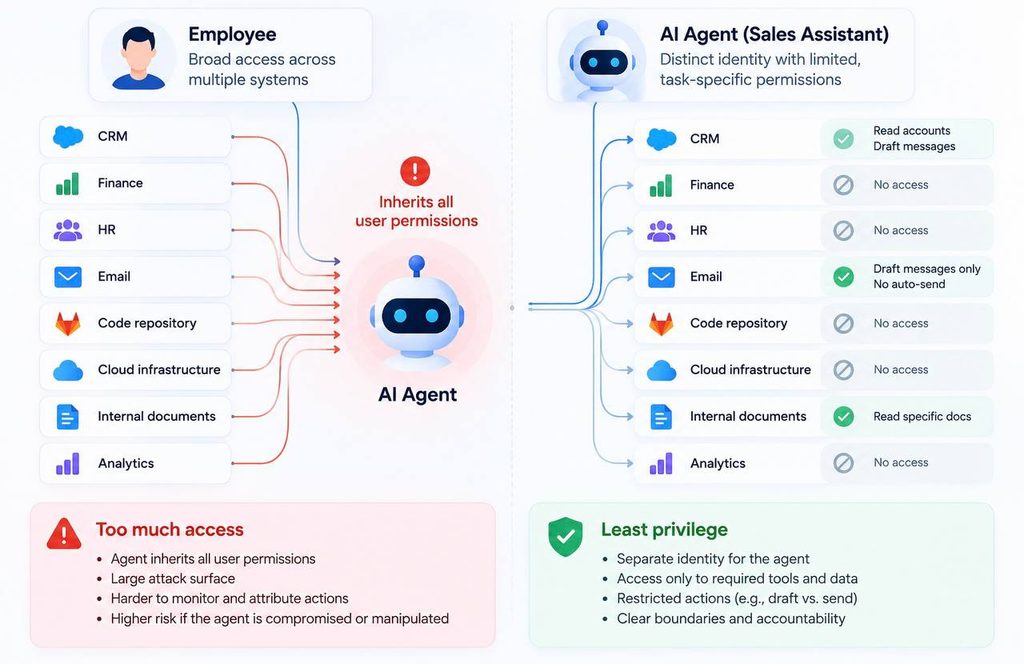
If an action occurs, the organization should be able to determine whether it was performed directly by a user, independently by an agent, or by an agent acting on behalf of a particular user. Without separate identities, those distinctions disappear. Imagine an employee has access to finance records, HR information, customer systems, analytics, and internal documents. If an AI assistant automatically inherits every permission the employee has, it receives an extremely broad attack surface. The user may normally access those systems deliberately and separately. The agent can potentially combine them inside a single workflow. A safer architecture gives the agent only the permissions necessary for its function.
A sales assistant may need read access to CRM accounts and permission to draft messages but not permission to delete customers or change billing information. A coding agent may require access to a specific repository without needing administrative access to the entire cloud environment. This is least privilege applied to autonomous software. But agent security needs to go further than traditional role-based permissions.
An identity might legitimately have access to a CRM while still not being authorized to change every field. It might have access to email but only be allowed to draft messages rather than automatically send them. A financial agent might prepare a transaction but require separate approval before money moves. The relevant security question becomes: What specific capability does this agent need for this specific task?
Microsoft’s 2026 security guidance recommends issuing narrowly scoped, short-lived permissions and treating tool invocations and agent-to-agent interactions as independent trust decisions. That creates a stronger boundary than simply deciding whether an agent can access an application.
Tool Access Should Be Explicit, Scoped, and Contextual
AI agents become operational through tools. A tool may allow an agent to query a database, search documents, interact with an API, create a support ticket, send an email, execute code, access cloud infrastructure, or modify a business record. Tool access therefore becomes one of the most important security boundaries in the agent architecture. OWASP recommends granting agents only the minimum tools needed for their task and restricting those tools to specific operations and resources. It also recommends enforcing authorization outside the agent itself rather than trusting the model to decide whether it should be allowed to execute an action. This distinction is fundamental. The AI can request an action. A deterministic security layer should decide whether the action is allowed. For example, an agent might determine that a customer deserves a refund.
The security architecture should independently verify whether the agent has permission to initiate refunds, whether the amount falls within an allowed threshold, whether the customer account is valid, and whether additional human approval is required. The agent should not be both the system proposing the action and the final authority approving it.
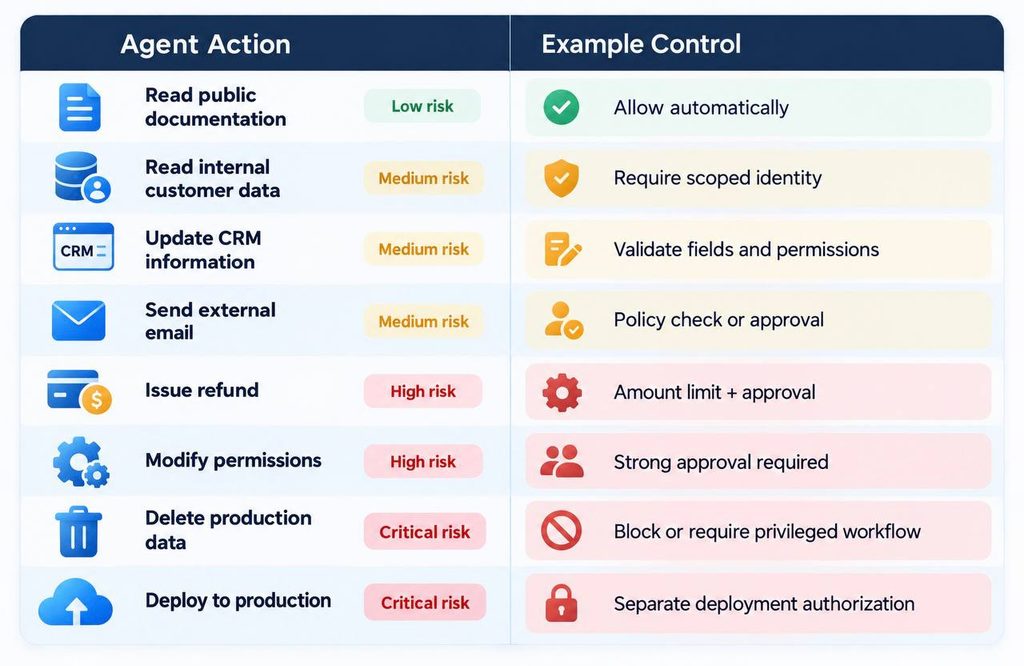
The goal is not to place a human in front of every tool call. That would remove much of the value of autonomous agents. Instead, businesses can classify actions by impact. Low-risk read operations can often execute automatically. Medium-risk actions can use policy checks and limits. High-impact actions – such as payments, privilege changes, bulk deletion, production deployment, or externally visible communication – can require additional verification. OWASP specifically recommends separating decision-making from execution for destructive, financial, administrative, or externally visible actions. It also recommends binding approvals to the exact action, target, parameters, actor, and time window rather than treating a generic “user approved” signal as sufficient authorization. This prevents a dangerous situation where the user approves one operation but the agent later modifies the target or parameters. The broader architectural principle is simple: Agents can reason flexibly, but execution boundaries should remain deterministic.
Data, Memory, and Other Agents Create Additional Trust Boundaries
Agent security becomes more complicated because tools are not the only source of risk. Agents consume information from many environments that the organization may not fully control. A research agent might read websites. A support agent may process customer messages. An enterprise assistant may retrieve files from shared storage. A procurement agent could analyze supplier documents or emails. Any of those sources can contain instructions that were never intended to control the agent. This is the core problem behind indirect prompt injection. An attacker may place malicious instructions inside content that appears to be ordinary data. When the agent retrieves the content, it may interpret those instructions as part of the task. A document could attempt to tell the agent to ignore previous instructions, retrieve sensitive information, invoke another tool, or send data somewhere else. The organization therefore cannot assume that information retrieved by the agent is trusted simply because the agent was allowed to access the source. External and retrieved content should be treated as potentially hostile input. Sensitive tool execution should remain protected even when the model becomes confused about what it has been instructed to do. Memory adds another concern. Agents may preserve information between tasks to create continuity or personalization. But if untrusted information enters persistent memory, it can influence future sessions long after the original interaction has ended. OWASP identifies memory poisoning as a specific agentic risk and recommends controlling what can be persisted, isolating memory between users or contexts, and preventing sensitive data from being stored unnecessarily. Multi-agent systems introduce an additional layer. One agent may ask another agent to perform a specialized task. That second agent may call another service or delegate again.A workflow can quickly become a chain of identities and permissions. If each agent automatically trusts instructions from another agent, compromise can propagate through the system.
Agent-to-agent communication should therefore be treated like service-to-service communication in a zero-trust architecture.
Each agent needs an identity. Messages should be attributable. Delegated authority should have limits. One agent should not automatically inherit every permission belonging to another. Microsoft similarly recommends treating multi-agent relationships as independent trust decisions rather than assuming agents operating inside the same system should automatically trust one another. Microsoft Learn
As agent ecosystems become larger, this becomes increasingly important. A multi-agent environment without clear boundaries can turn one manipulated agent into an entry point for several other systems.
Runtime Control Matters Because Authentication Is Not Enough
An agent can be correctly authenticated and still attempt a dangerous action. This is one of the key differences between traditional IAM and agent security. Authentication tells the system which agent is acting. Authorization determines what the agent is normally allowed to do. Runtime control asks a third question: Does this particular action make sense in this particular context? Consider a customer-service agent that legitimately has permission to issue refunds up to $100. A request for a $25 refund may be completely normal. If the agent suddenly attempts to issue 5,000 refunds within several minutes, every individual transaction may technically fall inside its permission scope while the overall behavior is obviously abnormal. Static authorization alone cannot solve that problem. Runtime controls can evaluate frequency, volume, target resources, action type, sensitivity, session context, and previous behavior.The same principle applies elsewhere. A coding agent normally modifying one repository should not suddenly access unrelated repositories. A research agent usually reading documents should not unexpectedly attempt to invoke administrative tools. An agent with permission to email customers may require investigation if it suddenly begins sending thousands of messages. Monitoring therefore needs to focus on behavior as well as identity.
OWASP recommends structured audit logging, anomaly detection, limits on tool-chain depth and retries, and circuit breakers that can stop runaway or unexpected agent behavior. Rate limits are particularly important. Agentic systems can execute operations at machine speed. A mistake that would take a human hours to reproduce manually may happen hundreds or thousands of times before someone notices.
Limits on requests, transactions, messages, token consumption, recursive agent calls, and tool usage can significantly reduce blast radius.
Another important principle is fail closed. If an authorization service is unavailable, approval cannot be verified, or a tool’s security policy is unknown, the system should not simply allow the action because the agent requested it. This may appear conservative, but autonomous systems can turn small failures into rapid sequences of actions. Runtime security therefore acts as the final boundary between intelligent decision-making and real-world consequences.

Give AI agents the access they need — and nothing more — with Ficus Technologies.
Contact usConclusion
AI agents create a fundamentally different access problem from traditional applications.They do not simply receive information and return an answer. Increasingly, they can decide which systems to access, which tools to use, and which actions to perform.That means AI security cannot stop at the model. Businesses need to secure the complete path from identity to permission to tool call to execution. Each agent should have a distinct identity. Permissions should be scoped to the specific task and kept as short-lived as possible. Tools should be explicitly authorized. High-impact operations should pass through deterministic policy checks or approval mechanisms. External data and agent memory should be treated as untrusted inputs. Multi-agent communication should create explicit trust relationships rather than implicit ones. And once agents are operating, organizations need visibility into what they actually do. The central design principle is not to eliminate autonomy. It is to make autonomy bounded. Businesses can allow agents to reason dynamically while keeping access, permissions, execution, and high-impact actions inside clear technical boundaries. The strongest agent architecture therefore separates two responsibilities: AI decides what it wants to do. Security decides what it is actually allowed to do.
Why Ficus Technologies?
At Ficus Technologies, we help businesses move AI from experimentation into secure, production-ready systems. AI agents often sit at the intersection of application development, cloud infrastructure, APIs, enterprise data, identity, automation, and cybersecurity. Securing them requires more than adding a prompt filter or connecting another security tool. The architecture needs clear trust boundaries around how agents authenticate, which resources they can reach, what tools they can invoke, and how their actions are controlled. Our expertise across AI development, custom software, cloud architecture, DevOps, API integration, data platforms, and cybersecurity allows us to design agentic systems with security built into the execution layer. That can include scoped agent identities, least-privilege permissions, secure API and tool integration, approval workflows, observability, runtime controls, and architecture that keeps sensitive actions outside unrestricted model control. As autonomous agents become more capable, businesses will need systems that can benefit from that autonomy without giving software unlimited authority.
Build AI agents that can act – without giving them access to everything – with Ficus Technologies.
AI agent security protects autonomous AI systems that can access data, invoke tools, interact with applications, and perform actions on behalf of users or businesses.
Agents can take actions rather than only generate responses. That introduces risks around permissions, tool use, identity, external systems, and autonomous execution.
Generally, agents should have their own identifiable and scoped permissions rather than automatically inheriting every permission available to a user.
It means giving an agent only the data, tools, resources, and actions required for its specific task, ideally for the shortest practical period.
High-impact actions such as payments, account recovery, privilege changes, bulk deletion, production deployment, or other irreversible operations are strong candidates for additional approval.




 Success...!