
AI is powerful — but it is not always reliable.
In 2026, organizations are integrating AI into decision-making, customer interactions, and operations. But alongside its benefits, a critical risk is becoming more visible: AI hallucinations. These are not minor errors. They are confident, incorrect outputs that can mislead users, disrupt operations, and damage trust.
Product teams building AI-driven features.
Business leaders evaluating AI risks.
Organizations using generative AI in operations.
- AI hallucinations are a systemic limitation, not a rare bug.
- They can impact decisions, operations, and customer trust.
- The biggest risk is over-reliance on AI outputs.
- Mitigation requires architecture, governance, and monitoring.
What Are AI Hallucinations
AI hallucinations occur when models generate outputs that are incorrect, misleading, or entirely fabricated — while presenting them as accurate.
This happens because AI models do not “know” facts in the traditional sense. They generate responses based on patterns in data, not verified truth.
As a result, outputs can sound highly confident, even when they are wrong.
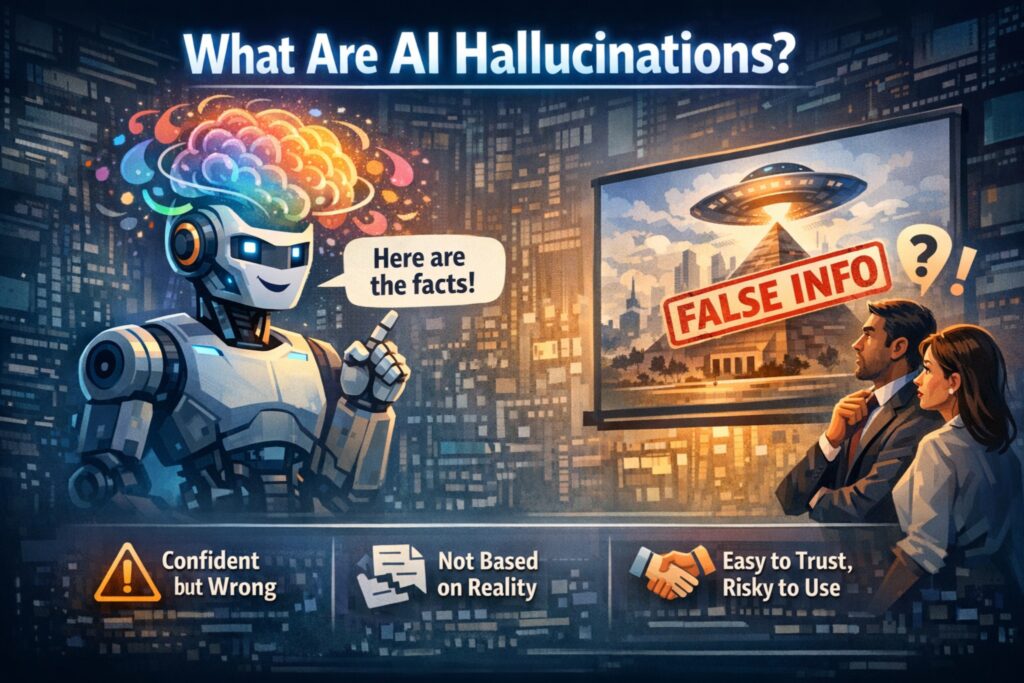
In business environments, this creates a dangerous dynamic. The more natural and fluent AI becomes, the easier it is to trust it — even when that trust is misplaced.
Why Hallucinations Are Increasing
The risk of hallucinations is growing as AI adoption scales.
One reason is broader use cases. AI is no longer limited to simple tasks. It is now used in decision support, analytics, customer communication, and content generation — areas where accuracy is critical.
Another factor is model complexity. As models become more advanced, they generate more sophisticated responses. However, this does not eliminate hallucinations — it often makes them harder to detect.
There is also a speed factor. Organizations are deploying AI quickly to stay competitive. In many cases, governance and validation processes lag behind implementation. This creates a gap between capability and control.
Build AI systems you can trust — with Ficus Technologies!
Contact usThe Business Impact of AI Hallucinations
AI hallucinations can have direct and measurable consequences. They can lead to incorrect business decisions when AI-generated insights are treated as reliable data. They can damage customer trust when AI systems provide false or inconsistent information. They can introduce operational risks, especially in areas such as finance, healthcare, or compliance, where accuracy is critical.
But the most significant impact is reputational. A single high-profile failure can undermine confidence in AI systems across the organization. Trust, once lost, is difficult to rebuild.
The Numbers Behind the Risk
The scale of the problem is reflected in industry trends. More than 60% of organizations report concerns about AI accuracy and reliability, particularly in high-stakes use cases.
At the same time, over 50% of AI users admit they cannot always distinguish between correct and incorrect AI outputs. As AI adoption grows, nearly 70% of companies are investing in AI governance and validation frameworks to address these risks. Despite this, incidents continue.
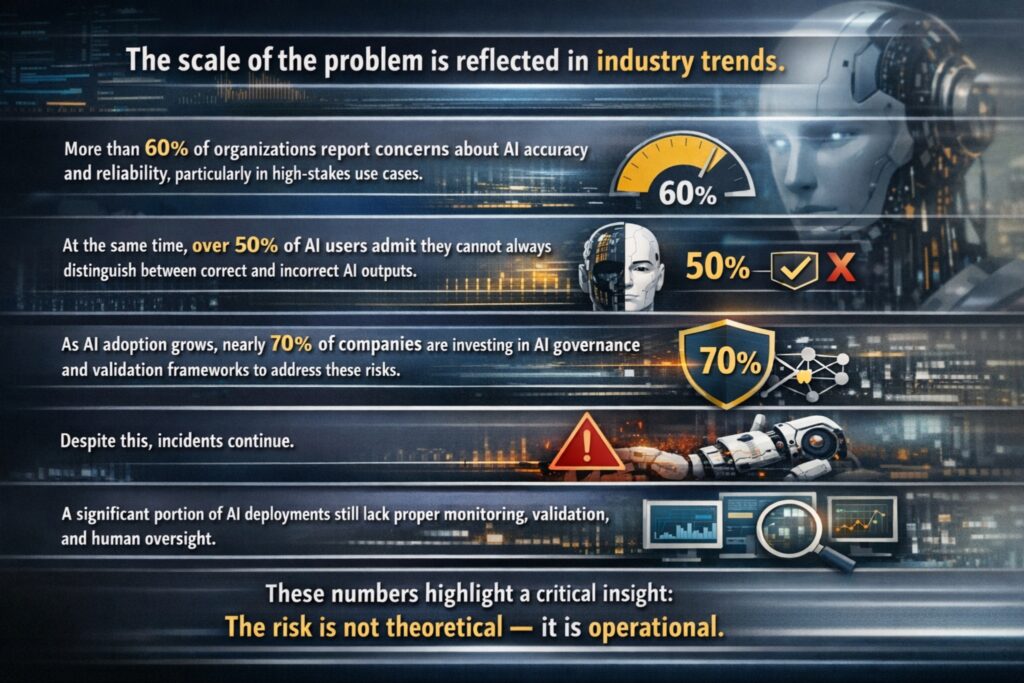
A significant portion of AI deployments still lack proper monitoring, validation, and human oversight. These numbers highlight a critical insight: the risk is not theoretical — it is operational.
Why Leaders Underestimate the Risk
One of the biggest challenges is perception. AI systems often appear reliable because they generate coherent and confident responses. This creates a false sense of accuracy.
Another issue is over-automation. Organizations may rely too heavily on AI outputs without sufficient validation, especially in high-volume environments.
There is also a lack of visibility. Hallucinations are not always obvious. In many cases, errors go unnoticed until they cause measurable impact.
Finally, there is pressure to scale. Companies prioritize speed and innovation, sometimes at the expense of risk management.
How to Reduce AI Hallucinations
Hallucinations cannot be completely eliminated — but they can be managed.
The first step is grounding. AI systems should be connected to reliable data sources, reducing the likelihood of generating unsupported outputs.
Validation layers are essential. Outputs should be checked against rules, data, or human review before being used in critical processes.
Human-in-the-loop systems provide additional control. AI should support decisions, not replace them entirely — especially in high-risk scenarios.
Monitoring is critical. Organizations must track model performance, identify anomalies, and continuously improve systems.
Finally, governance must be embedded. Policies, guidelines, and accountability structures are necessary to ensure responsible AI use.
From Risk to Responsible AI
Leading organizations are not avoiding AI — they are managing it more effectively. They treat AI as a system, not a tool. They integrate validation, monitoring, and governance into their architecture. They align AI usage with business risk levels.
The goal is not to eliminate risk — but to control it.
Conclusion
AI hallucinations are one of the most underestimated risks in modern business systems.
In 2026, the challenge is not just adopting AI — but using it responsibly.
Organizations that understand and manage this risk will build more reliable systems, stronger trust, and sustainable competitive advantage.
Why Ficus Technologies?
Ficus Technologies helps businesses implement AI systems that are reliable, scalable, and aligned with real-world risk management requirements.
Incorrect or fabricated outputs generated by AI models.
Because AI generates responses based on patterns, not verified truth.
No, but they can be reduced and controlled.
Over-reliance on AI without validation.




 Success...!