Modern digital systems are expected to operate continuously, even as infrastructure changes, traffic fluctuates, and failures occur. Cloud-native architectures, distributed applications, and AI-powered services have increased both the capabilities of software and the complexity of keeping it reliable.
By 2026, resilience engineering has become more than a technical discipline. It represents a design philosophy focused on ensuring that systems continue delivering business value despite disruptions. Rather than assuming failures can be prevented entirely, resilient organizations build platforms that anticipate failure, limit its impact, and recover quickly.
For technology leaders, resilience is no longer measured by whether incidents occur. It is measured by how effectively systems absorb disruption without affecting customers or business operations.
DevOps, SRE, and engineering teams managing cloud-native infrastructure and distributed applications.
Organizations operating business-critical services where reliability, uptime, and operational continuity directly impact customer trust and business performance.
- Resilience engineering focuses on designing systems that continue operating despite failures rather than attempting to eliminate failures completely.
- What works in 2026 is fault isolation, automation, observability, rapid recovery, and architecture designed around real operating conditions.
- What fails is relying only on redundancy, manual recovery processes, and infrastructure models built around the assumption that failures are rare.
Failure Is Now an Expected Condition
Traditional infrastructure assumed that failures were exceptional events. Modern distributed systems operate differently.
Cloud platforms, APIs, third-party services, containers, and microservices introduce many moving parts. Hardware fails, networks become unavailable, deployments introduce unexpected behavior, and external dependencies experience outages.
Resilience engineering accepts this reality. Instead of designing systems that never fail, organizations build systems capable of isolating failures, maintaining core functionality, and recovering automatically whenever possible.
The objective shifts from preventing disruption to minimizing business impact.
Reliability Depends on Architecture
Technology alone cannot create resilience. System architecture determines whether failures remain isolated or cascade across platforms.
Clear service boundaries, fault isolation, redundancy, graceful degradation, and independent deployment models all contribute to more resilient environments. When systems are tightly coupled, small failures can move quickly across services. When systems are designed with clear boundaries, disruption is easier to contain.
Organizations increasingly evaluate resilience during system design rather than after deployment. This architectural mindset allows teams to anticipate failure paths before they become production incidents.
Downtime Is Becoming More Expensive
The business impact of outages continues to grow as organizations depend more heavily on digital platforms.
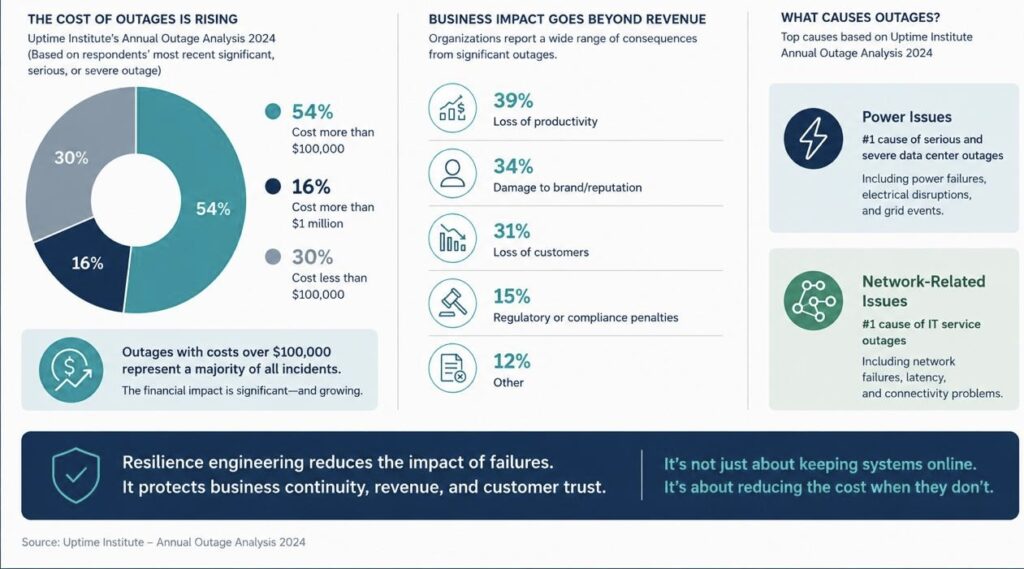
According to Uptime Institute’s Annual Outage Analysis 2024, 54% of respondents said their most recent significant, serious, or severe outage cost more than $100,000, while 16% said the cost exceeded $1 million. The same report notes that power issues remain the most common cause of serious and severe data center outages, while network-related issues are the largest single cause of IT service outages.
These numbers show why resilience engineering is increasingly viewed as a business capability rather than simply an infrastructure concern. The objective is not only to keep systems online, but to reduce the financial and operational impact when failures occur.
Observability Changes the Response Model
Monitoring tells teams when something has failed. Observability helps explain why.
Modern organizations increasingly combine metrics, logs, traces, and business telemetry into unified operational visibility. Instead of responding only after alerts occur, engineering teams identify abnormal behavior before failures become customer-facing incidents.
This shift enables faster diagnosis, shorter recovery times, and more informed operational decisions. Observability becomes one of the foundations of resilience because teams cannot recover quickly from conditions they cannot understand.
Automation Strengthens Recovery
Recovery speed has become just as important as uptime.
Infrastructure automation allows organizations to replace failed resources, reroute traffic, scale services, and restore environments without waiting for manual intervention. Continuous delivery pipelines, infrastructure as code, automated rollbacks, and self-healing platforms reduce both operational overhead and recovery time.
Automation does not eliminate incidents. It reduces their duration and business impact.
Everything fails, all the time.
Werner Vogels, CTO of Amazon
Resilience Is Becoming an Engineering Discipline
Industry research reflects a broader shift toward resilience-focused operations.
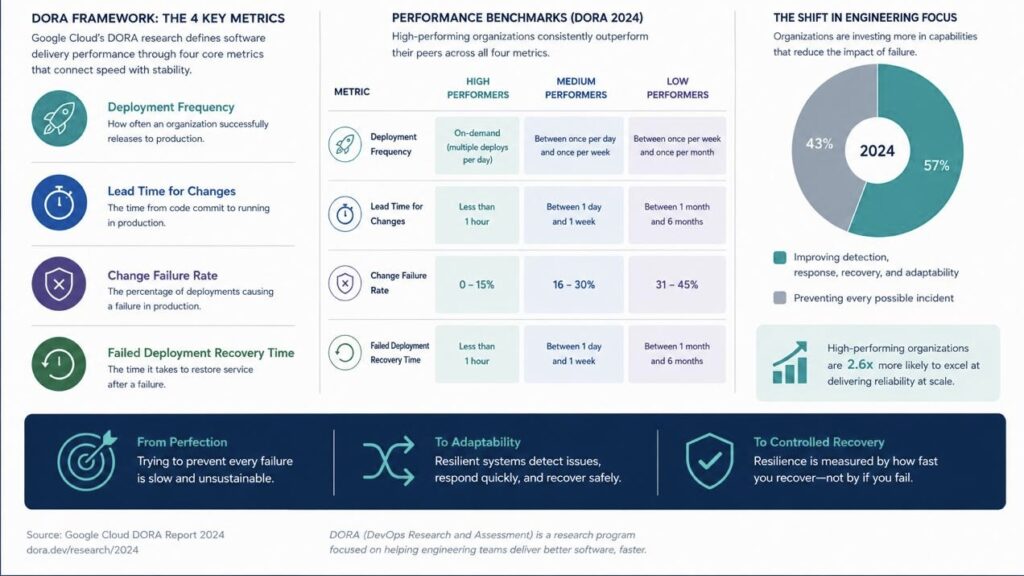
Google Cloud’s DORA research program defines software delivery performance through metrics that include deployment frequency, lead time for changes, change failure rate, and failed deployment recovery time. These metrics connect delivery speed with operational stability, showing why resilience is increasingly evaluated as part of software delivery rather than as a separate infrastructure concern.
The common pattern is clear. Organizations increasingly invest less in preventing every possible incident and more in improving detection, response, recovery, and system adaptability.
Resilience is no longer measured by perfection. It is measured by controlled recovery.
Why Redundancy Alone Is No Longer Enough
For many years, resilience was associated primarily with redundancy. Organizations invested in backup servers, secondary data centers, and disaster recovery plans designed to restore operations after major incidents.
While these measures remain important, they are no longer sufficient for modern distributed environments. Cloud-native platforms rely on interconnected services, APIs, deployment pipelines, and external dependencies where failures can emerge from configuration changes, software releases, traffic patterns, or third-party systems.
Modern resilience depends less on duplicate infrastructure alone and more on how quickly systems detect issues, isolate failures, recover automatically, and improve after incidents.
Organizations that focus only on redundancy risk overlooking the operational capabilities that determine resilience in real-world conditions.
Need resilient cloud platforms that keep your business running?
Contact usConclusion
Failures remain inevitable. What distinguishes resilient organizations is not the absence of disruption, but their ability to continue operating despite it.
Resilience engineering represents a shift from reactive recovery toward proactive system design. Organizations that invest in resilient architectures, automation, observability, and platform engineering build digital systems capable of supporting continuous innovation without sacrificing operational stability.
In 2026, resilience is becoming one of the defining characteristics of modern software architecture. The strongest systems are not those that promise never to fail, but those designed to fail safely, recover quickly, and protect business continuity under pressure.
Why Ficus Technologies?
Ficus Technologies helps organizations design resilient cloud-native platforms capable of supporting continuous delivery, operational stability, and long-term scalability.
As digital systems become more distributed, resilience can no longer depend on infrastructure alone. It requires architecture, automation, observability, and engineering practices that work together.
Ficus focuses on building scalable platforms where failure impact is contained, recovery is faster, and operational visibility supports better decision-making. This allows organizations to maintain reliable digital experiences even as infrastructure and business requirements become more complex.
Resilience engineering is the practice of designing systems that continue operating effectively despite failures, disruptions, or unexpected conditions.
Reliability focuses on consistent operation. Resilience focuses on maintaining service and recovering quickly when failures occur.
Distributed architectures introduce more dependencies and potential failure points, making resilience essential for maintaining service continuity.
Yes. Automation reduces recovery time, improves consistency, and minimizes the impact of operational failures.
Observability platforms, infrastructure as code, automated recovery, fault isolation, distributed architectures, and platform engineering all contribute to resilient systems.







 Success...!