
AI adoption has moved much faster than most enterprise governance models were designed to handle.
Teams can now experiment with new models, build copilots, connect AI to internal data, automate workflows, and deploy agents in weeks rather than months. Business units often start using new AI tools before central IT or security teams have complete visibility into them. At the same time, companies are under growing pressure to control data exposure, model behavior, third-party dependencies, security risks, regulatory requirements, and the decisions AI systems are allowed to make. This creates an uncomfortable tension. Organizations want innovation to move quickly, but they also want confidence that AI is being used through responsible AI governance. The usual response is to add approvals, review committees, policies, documentation, and security checks. When those controls are introduced too late or managed manually, governance can become exactly what teams fear: another layer of process standing between an idea and production.
But weak governance creates its own delays. Projects reach late-stage security reviews and need to be redesigned. Legal teams discover data restrictions after models have already been integrated. Different departments create duplicate AI solutions because nobody knows what already exists. Production incidents force teams to stop deployments and investigate systems that were never properly documented. The real conflict is therefore not governance versus innovation.It is slow governance versus governance designed for speed.
- AI governance does not automatically slow innovation; poorly designed governance does.
- Manual approvals and late-stage reviews create some of the biggest bottlenecks.
- The goal is not maximum control but enough control for the level of risk involved.
Why AI Governance Became a Speed Problem
The first generation of enterprise AI adoption was relatively easy to govern because much of it happened through isolated experiments. A team built a proof of concept, tested a chatbot, experimented with a model, or used generative AI for internal productivity. The number of systems was limited, and human involvement remained high.That environment is changing quickly. AI is moving into customer service, development, finance, analytics, cybersecurity, marketing, operations, and internal knowledge systems. Models are becoming connected to proprietary data and production applications. AI agents can retrieve information, call tools, trigger workflows, and increasingly perform actions rather than simply generate answers. Governance that worked for ten experiments may not work for hundreds of AI-powered workflows. IBM’s 2026 research among technology executives illustrates the scale of the problem. 77% of surveyed organizations said AI adoption was already outpacing their governance capabilities, while 70% said teams were deploying technology faster than IT could track it. This creates a visibility problem before it becomes a compliance problem.
When organizations cannot easily answer which models are being used, what data they access, who owns them, what actions they can take, and which third parties they depend on, every governance decision becomes slower because teams first need to reconstruct the environment. The organization is not losing speed because it has governance. It is losing speed because governance does not scale at the same rate as adoption.
Where Companies Actually Lose Speed
Governance becomes a bottleneck when controls are disconnected from the way AI systems are actually built.
A product team may spend several weeks developing an AI feature before security becomes involved. Security then discovers that sensitive information is being sent to an external model. Legal identifies restrictions on how the data can be processed. Compliance asks for documentation that was never created. Engineering needs to redesign the integration, change providers, or add additional controls.
The review itself may only take a few days. The expensive part is discovering important requirements after architectural decisions have already been made.
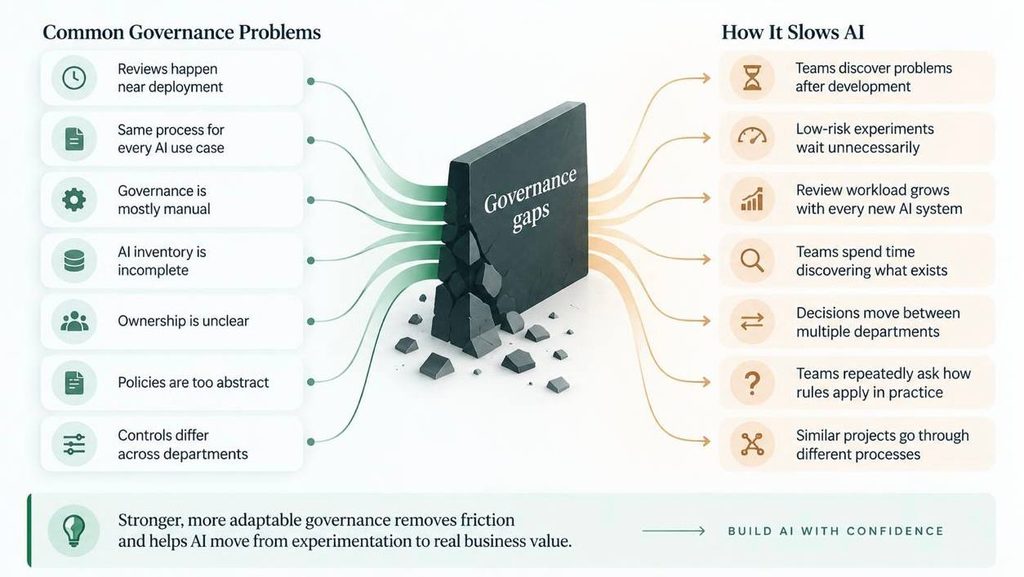
The same pattern appears when every AI use case follows the same approval process. An internal writing assistant that summarizes non-sensitive marketing material should not necessarily require the same governance process as an AI system making employment recommendations or accessing financial information.
When organizations treat all AI as equally risky, governance resources become overloaded. Low-risk projects wait unnecessarily, while teams responsible for truly sensitive systems receive less attention. This is where governance creates friction rather than protection.
Governance Should Start With Risk, Not With AI
One of the most common problems in enterprise AI governance is treating “uses AI” as the primary risk category.That is too broad.
An AI system that summarizes public documents does not create the same risk as a system that accesses confidential customer information. A coding assistant generating a draft function is different from an autonomous agent capable of changing production infrastructure. An internal recommendation tool is different from a system influencing employment, credit, healthcare, or other high-impact decisions. Effective governance starts by understanding what the system actually does.
Important factors include the sensitivity of the data, the impact of an incorrect output, whether the AI interacts directly with customers, whether humans review its decisions, what external providers are involved, and whether the system can perform actions independently. This allows organizations to create different governance paths. Low-risk experimentation can move quickly under predefined rules. Medium-risk applications may require additional testing and monitoring. High-impact systems receive deeper security, legal, compliance, and human oversight. The result is not weaker governance. It is governance concentrated where it creates the most value.
The Governance Gap Is Already Visible
The challenge is becoming especially clear as organizations move toward agentic AI.
IBM reported in June 2026 that only 11% of surveyed technology leaders considered their organizations fully prepared for the expected scale of AI-agent deployment, even though respondents expected the number of deployed agents to grow substantially. The same research found that organizations embedding controls directly into their AI systems experienced 25% fewer incidents than those relying on more manual governance approaches. Deloitte found a similar gap. Only 21% of enterprises in its international survey reported having mature governance for agentic AI, despite rapid adoption plans. Leadership also feels the tension directly. In Deloitte’s Q2 2026 CFO survey, 59% identified balancing pressure to deploy AI quickly while managing risk as the biggest challenge in developing enterprise-wide AI governance.These numbers point to an important shift.
AI Inventories Become Essential
Companies cannot govern AI systems they cannot see. As AI adoption spreads across departments, maintaining visibility is becoming increasingly difficult because new tools enter the organization through many different channels. IT teams deploy centralized platforms, developers connect directly to external model APIs, employees use AI features inside SaaS products, business teams build their own automations, and vendors continuously add AI capabilities to software that is already in use.
The result is an AI environment that can expand much faster than traditional asset-management processes can track. IBM reported in 2026 that only 18% of organizations maintain a current and complete AI inventory, while 70% of technology executives say teams across the business are deploying technology faster than IT can track it.
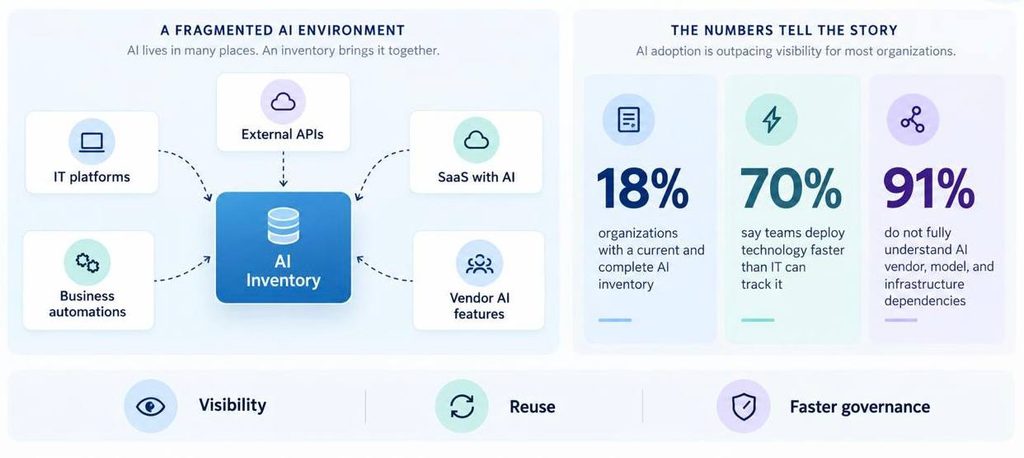
That gap becomes more important as AI systems become interconnected. A model may depend on an external provider, connect to several internal data sources, use third-party infrastructure, and trigger actions through other enterprise applications. IBM also found that 91% of surveyed executives do not fully understand their organization’s dependencies across AI vendors, models, and infrastructure.
An AI inventory therefore needs to contain more than the name of a model or application. Organizations need visibility into who owns each system, which models and providers it uses, what information it can access, which applications it connects to, what actions it can perform, and what level of business or security risk it represents. This information becomes particularly important when a provider changes a model, a vulnerability appears, access permissions need to be revoked, or an AI system begins affecting a new business process.
Challenges of Balancing Governance and Innovation
The difficult part is not deciding whether AI needs governance. The harder question is determining how much control is appropriate without creating unnecessary friction.
AI technologies evolve quickly. Models improve, capabilities change, new providers enter the market, and use cases expand faster than traditional corporate policies can usually be rewritten. Rules that are too broad leave teams unsure about what they are allowed to do. Rules that are too specific can become obsolete almost as soon as they are published.
This makes adaptability one of the most important characteristics of modern AI governance. Organizations need stable principles around areas such as data protection, accountability, security, transparency, and human oversight, while allowing the technical implementation of those principles to evolve. Governance should establish boundaries without attempting to predict every future AI capability.
Ownership creates another challenge. AI systems often sit between several organizational functions, and responsibility can easily become fragmented. Security may expect legal to decide whether a use case is acceptable. Legal may believe the AI team owns the risk. Business teams may assume IT is responsible because the system uses enterprise technology.
When accountability is unclear, even relatively simple decisions can move between departments for weeks. Clear decision rights help reduce this problem. Organizations need to define who owns the business outcome, who owns the technical system, who evaluates specific categories of risk, and who has final authority when those perspectives conflict. Governance becomes faster when everyone understands their role before a problem appears.

Turn AI governance into an enabler, not a bottleneck — with Ficus Technologies.
Contact usConclusion
The debate between AI governance and innovation is often framed incorrectly. Companies do not lose speed simply because they govern AI. They lose speed when governance is manual, fragmented, inconsistent, or introduced too late.
Weak governance creates delays as well. Systems have to be redesigned. Security problems appear after deployment. Teams duplicate work. AI environments become difficult to understand. Regulatory requirements trigger emergency remediation.
The alternative is not choosing innovation over control. It is designing control for innovation. Risk-based reviews, reusable guardrails, approved AI platforms, automated evaluations, clear ownership, strong visibility, and continuous monitoring can allow organizations to move faster because teams understand the boundaries before they start building. As AI systems become more autonomous and more deeply connected to business operations, this capability will become increasingly important. The companies that move fastest will not be the ones that remove governance. They will be the ones that make governance part of how AI is built.
Why Ficus Technologies?
At Ficus Technologies, we help businesses turn AI experiments into secure, scalable products and workflows. From AI integration and custom software development to cloud architecture, data platforms, automation, and security, we help organizations introduce the technical foundations needed to innovate without losing visibility and control.
Build AI that can move fast and scale responsibly — with Ficus Technologies.
AI governance is the set of policies, responsibilities, technical controls, and processes used to manage how AI systems are developed and used.
It can if governance relies on manual approvals and late-stage reviews. Well-designed governance can reduce uncertainty and help teams move faster.
It applies different levels of oversight depending on factors such as data sensitivity, business impact, autonomy, and potential harm.
Agents can perform actions, access systems, and execute multi-step workflows, making permissions, monitoring, and accountability more important.
Many controls can be automated, including model access, data policies, evaluations, logging, monitoring, and deployment checks.




 Success...!