Modern organizations rarely suffer from a shortage of technology. There is a platform for almost every problem: analytics, automation, cybersecurity, customer engagement, observability, project management, AI, cloud optimization, integration, developer productivity, data governance, and dozens of other categories. When a new challenge appears, buying another tool often feels like the fastest path forward. And sometimes it is.
The problem begins when individual purchasing decisions accumulate faster than the architecture connecting them. One team introduces a new analytics platform. Another adds an automation tool. Security deploys another control layer. Engineering adopts a new development service. Business teams subscribe to specialized SaaS applications, while AI tools appear across almost every department. Each decision can make sense locally while making the organization more complicated globally. Recent data illustrates how far this can go. MuleSoft’s 2026 Connectivity Benchmark reports that the average organization now manages 957 applications, while only 27% are connected. At the same time, 71% of respondents said their infrastructure makes systems overly dependent on one another, and 82% identified data integration as one of their biggest AI challenges. The issue is therefore not that companies buy too much technology simply because procurement teams make poor decisions. The deeper problem is structural. Tools produce visible capabilities quickly, while architecture produces value more slowly and indirectly. A new application can solve an immediate problem in weeks. Improving APIs, integration patterns, data models, identity, platform boundaries, and ownership may take months before the benefits become obvious.
That creates a persistent investment imbalance. Organizations keep adding capabilities at the surface while the foundation underneath them becomes increasingly difficult to change.
- Tool purchases often solve visible problems faster than architecture investments.
- Local optimization can create organization-wide complexity.
- Integration cost grows as applications, APIs, data sources, and vendors multiply.
More Software Does Not Automatically Mean More Capability
Adding software can increase capability, but the relationship is not linear. The first project-management platform may eliminate spreadsheets and improve coordination. The second may support a specialized engineering workflow. By the time different departments operate ten separate planning and collaboration tools, however, each additional product may contribute less value while increasing the amount of information that needs to move between systems.
The same pattern appears throughout enterprise technology. Marketing has its own customer data. Sales operates a CRM. Support maintains another customer history. Finance uses separate billing information. Product teams capture behavioral events, while analytics creates additional derived datasets. Individually, every system may be useful. Collectively, they create multiple representations of the same business. At that point, software acquisition stops being only a capability decision. Every tool also becomes an architectural commitment. It introduces another identity model, data structure, API, vendor relationship, permission system, integration requirement, upgrade lifecycle, security surface, and source of operational ownership. Even if the subscription itself is inexpensive, the organization must continue carrying these relationships for as long as the product remains part of the environment.
That hidden cost is easy to underestimate because it rarely appears on the original purchase order. The tool has a price. The architecture required to make it work with everything else has a lifecycle.
Buying Technology Creates Visible Progress
One reason companies repeatedly invest in tools is that purchasing technology creates an immediate and understandable result. A team says customer analytics are inadequate. A new platform is selected. The implementation begins. Leaders can see the budget, timeline, vendor, functionality, and expected users.
Architecture is harder to present in the same way. A proposal to improve service boundaries, introduce an API layer, simplify identity, standardize event schemas, modernize shared data models, or redesign platform ownership may not produce a new user-facing capability immediately. Much of the value appears later through faster integrations, easier product changes, fewer incidents, simpler onboarding, or reduced duplication. That creates an organizational bias toward visible delivery. A new tool can be associated with a specific feature. Good architecture often appears as an absence of problems. Nobody celebrates the integration that took two days instead of eight weeks because the APIs were already well designed. Nobody notices that a new product team launched without building another customer database because a reusable data service already existed. Architecture creates leverage quietly.
Poor architecture becomes visible only after that leverage disappears.
Integration Becomes the Hidden Tax
The more tools an organization operates, the more important the relationships between them become.
A CRM is useful on its own, but significantly more useful when it can exchange information with billing, customer support, marketing, analytics, and product systems. The same principle applies to data platforms, AI services, identity systems, cloud infrastructure, and operational applications. This is where application growth becomes expensive. MuleSoft’s 2026 research found that organizations now operate an average of 957 applications, yet only 27% are connected. Organizations further along in agentic transformation actually reported even larger estates, averaging 1,057 applications.
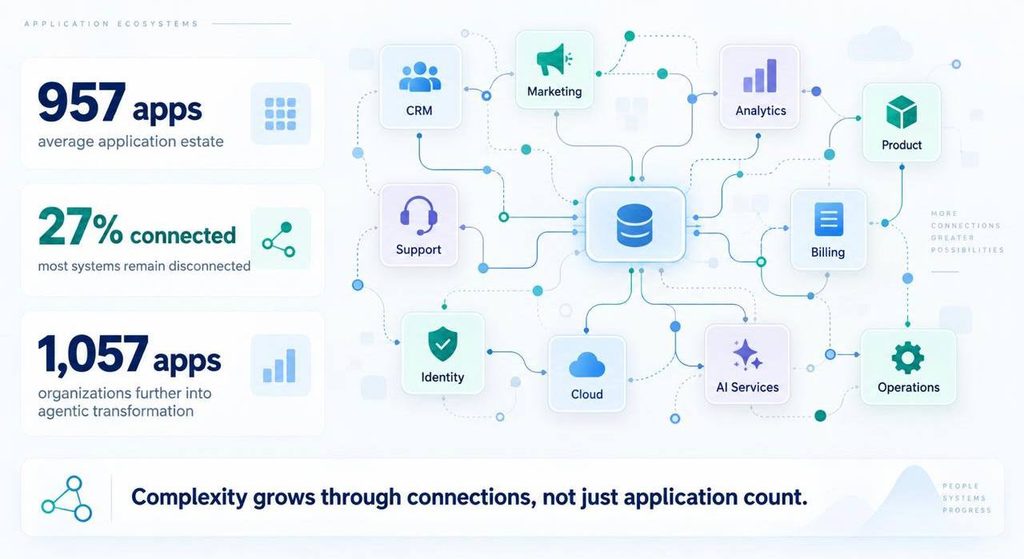
The numbers illustrate an important paradox: technology adoption can increase faster than the organization’s ability to connect what it already has. Integration work is also rarely finished. APIs change. Vendors update authentication. Data models evolve. Products are replaced. New privacy requirements appear. The integration that worked reliably for two years can suddenly require engineering attention because one dependency changed. Every additional system therefore adds more than one new thing to manage. It creates new relationships with the existing environment.Complexity grows through connections, not simply through application count.
Local Optimization Creates Enterprise Complexity
Most technology sprawl is not created by obviously bad decisions. It is created by good decisions made inside narrow boundaries. Marketing selects a platform that gives the marketing team better automation. Engineering adopts a service that improves developer productivity. Finance chooses software that simplifies forecasting. HR introduces another system to improve employee workflows. Each department can demonstrate value.
But nobody is necessarily responsible for optimizing the combined technology system. This is a classic local-versus-global optimization problem. A department may save ten hours per week while creating a new integration that requires engineering maintenance, another customer dataset that needs governance, another identity integration for security, and another vendor that procurement must manage. The local ROI can still be positive while the organization’s total complexity increases. Architecture exists partly to manage this tension. It does not mean central architects should choose every application. It means organizations need shared principles that prevent independent choices from creating incompatible foundations. Without those principles, autonomy gradually becomes fragmentation.
Tool Sprawl Is Accelerating Again
For several years, many organizations tried to consolidate their SaaS portfolios. AI is reversing part of that trend.
BetterCloud’s 2026 State of SaaS report found that the average application portfolio increased 11% year over year after two years of consolidation. Organizations now use an average of 27 AI-powered SaaS applications, representing roughly 22% of the portfolio. Only 56% of applications in use carry IT approval, leaving a substantial portion outside normal technology governance. This matters because AI products are rarely isolated productivity tools. Many request access to files, email, repositories, business applications, customer information, internal knowledge, or cloud environments. Every new AI service can therefore become another integration and data-access relationship. The architectural impact of AI adoption may be more important than the number of AI tools themselves.
Companies can experiment quickly by connecting another model or SaaS platform, but scaling those experiments requires decisions about identity, permissions, APIs, observability, data access, model gateways, evaluation, and ownership. AI is not creating the architecture problem. It is making weak architecture harder to ignore.
Tool-First and Architecture-First Investment Behave Differently
The difference between tool-first and architecture-first investment becomes clearer when both approaches are viewed over time. Tool-first investment is usually driven by an immediate need. A team has a problem, evaluates available products, selects a solution, and begins implementation. The value can appear quickly because the tool is designed to address a specific workflow, function, or department. This makes tool purchases easy to justify internally: the problem is visible, the cost is known, and the expected benefit is relatively easy to explain.
Architecture-first investment behaves differently. It may not solve one urgent problem as quickly, but it creates reusable capabilities that can support many future use cases. APIs, shared data services, identity platforms, event infrastructure, integration standards, internal platforms, and common security patterns often require more initial effort. Their value becomes stronger as more teams and products reuse them. This creates two very different investment curves.
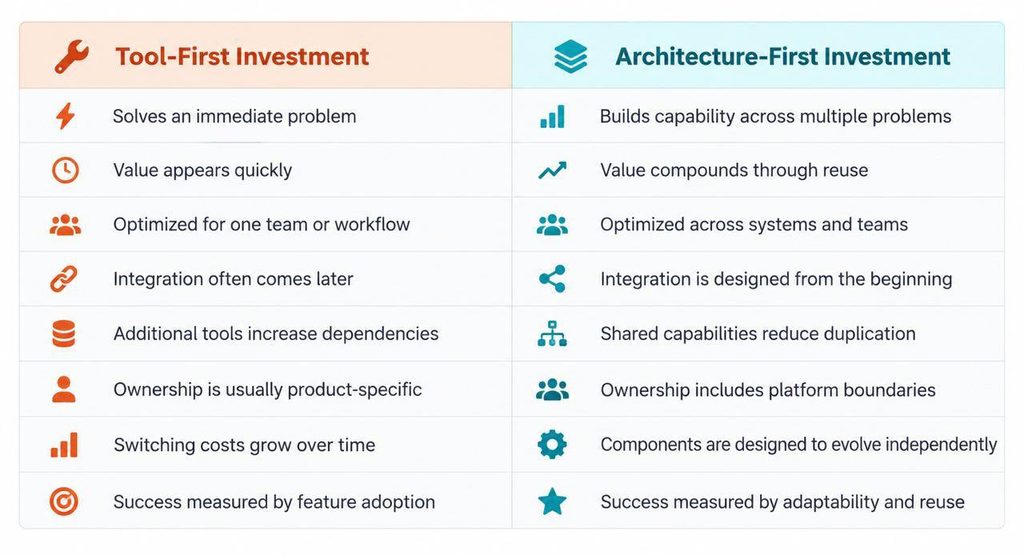
A new tool may deliver most of its value to the team that requested it. A strong architectural capability can reduce the cost of every project that comes after it. The first API may require significant design and engineering work, but the second, fifth, and twentieth application can connect to the same capability without recreating the integration from the beginning.
Architecture Debt Builds Quietly
Technical debt is usually associated with code, but organizations accumulate architectural debt in a similar way.
A temporary point-to-point integration becomes permanent. Two systems begin storing nearly identical information. One product needs access to another team’s database because no API exists. A shared library becomes critical infrastructure without clear ownership. A legacy application stays in place because six newer systems depend on it.
None of these decisions may cause an immediate failure. They reduce future freedom. A new feature takes longer because several systems need to change together. Replacing a vendor becomes difficult because proprietary data structures have spread throughout the architecture. Cloud migration slows because applications depend on environment-specific services. A security incident becomes harder to contain because identity and permissions cross unclear system boundaries. Architectural debt therefore behaves differently from a visible outage.
The system continues operating while the cost of change gradually increases. That is one reason organizations can underinvest in architecture for years without realizing how expensive the problem has become.

Invest in the architecture behind the tools — with Ficus Technologies.
Contact usConclusion
Companies overinvest in tools because tools make progress visible. They provide features, dashboards, users, implementations, and clear purchasing decisions. Architecture is easier to postpone because much of its value appears indirectly through faster change, stronger reuse, simpler integration, and reduced operational complexity.
But postponing architecture does not eliminate its cost. The cost reappears as integration projects, duplicated data, growing SaaS portfolios, cloud waste, vendor lock-in, inconsistent security, developer friction, and systems that become increasingly difficult to change. The answer is not to stop buying technology. It is to stop treating technology purchases as isolated decisions. Organizations need to understand which capabilities should be shared, which systems should own critical information, how applications communicate, where architectural boundaries sit, and how new technologies fit into the larger system. The companies that get the most from technology will not necessarily own the most tools. They will build architectures that allow the tools they choose to work together, evolve independently, and create value beyond the project that originally purchased them.
Why Ficus Technologies?
At Ficus Technologies, we help businesses move from fragmented technology stacks toward systems designed for long-term growth. Our work combines software architecture, custom development, cloud infrastructure, API integration, data engineering, platform modernization, automation, and AI. This allows us to address not only individual technology needs but also the connections and dependencies that determine whether those technologies can scale together. We help organizations simplify complex environments, modernize legacy systems, design reusable services, connect data and applications, and create technical foundations that make future product development easier rather than harder. The goal is not simply to add another tool to the stack. It is to build a technology environment where every new capability can create more value without creating unnecessary complexity.
Build technology that works as a system – with Ficus Technologies.
Different teams often purchase software to solve immediate local problems. Over time, those individual decisions can create a fragmented technology portfolio.
No. Consolidation can reduce duplication, but architecture is more about defining clear relationships, ownership, data flows, and interfaces between systems.
Good architecture increases reuse, reduces duplicated integrations, limits unnecessary systems, and makes applications easier to replace or evolve.
AI systems depend on connected data, APIs, permissions, identity, and reliable business systems. Fragmented architecture limits how useful AI can become.
Architecture should be proportional to impact. Teams can move quickly on isolated decisions while applying stronger design standards to shared data, infrastructure, identity, integrations, and critical systems.






 Success...!