
Digital transformation has never offered more technological possibilities. Organizations can build cloud-native platforms, integrate artificial intelligence, automate business processes, and deploy software faster than ever before. Yet despite rapid technological progress, many digital initiatives still fail to deliver meaningful business results.
The problem is rarely the technology itself. Modern platforms, frameworks, and cloud services have become increasingly mature and accessible. More often, projects struggle because technology decisions are disconnected from business priorities. Teams optimize for technical excellence while losing sight of the outcomes the business is trying to achieve.
By 2026, successful organizations are shifting their perspective. Rather than asking which technologies to adopt next, they are asking how technology can create measurable value, improve customer experiences, reduce operational costs, and support long-term business strategy.
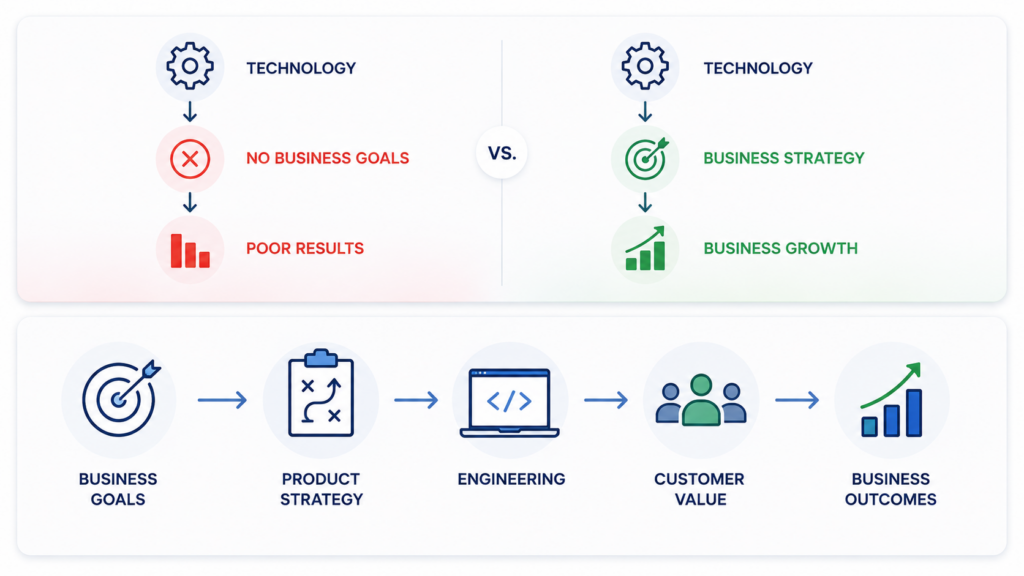
Technology becomes most valuable when it serves a clear business purpose.
Engineering and transformation teams modernizing legacy systems and adopting AI and cloud technologies.
Organizations aligning technology investments with business goals to improve performance, scalability, and long-term growth.
- Technology alone does not create business value. Organizations achieve better outcomes when engineering, product strategy, and business priorities are aligned around shared objectives.
- What works in 2026 is outcome-driven technology investment, cross-functional collaboration, and product thinking that connects engineering decisions with measurable business impact.
- What fails is adopting new technologies without a clear understanding of the problems they are meant to solve.
Innovation Doesn’t Guarantee Business Success
Every year organizations invest billions of dollars in emerging technologies. Artificial intelligence, cloud computing, automation, data analytics, and modern software architectures promise faster delivery, greater efficiency, and new revenue opportunities.
However, technology itself rarely guarantees success. Many organizations successfully deploy modern platforms but struggle to improve customer satisfaction, accelerate business growth, or increase operational efficiency. Projects are delivered on time and within budget, yet the expected business outcomes never fully materialize.
The difference often lies not in engineering quality but in strategic alignment. Technology can only create value when it addresses clearly defined business challenges.
Technology Should Support Strategy, Not Replace It
One of the most common mistakes in digital transformation is allowing technology decisions to drive business strategy rather than the other way around. Organizations sometimes adopt AI because competitors are doing so, migrate to the cloud without defining expected business outcomes, or redesign entire platforms simply to follow architectural trends. These initiatives often increase technical complexity without creating proportional business value.Successful organizations approach technology differently.
They begin with business priorities, identify the operational or customer problems that need to be solved, and then select technologies that directly support those objectives. In this model, technology becomes an enabler rather than the destination itself.
Most Digital Projects Fail for Business Reasons
Research from Boston Consulting Group, McKinsey, and Gartner consistently shows that the majority of digital transformation initiatives struggle to achieve their intended business objectives. While technology challenges certainly exist, the primary reasons for failure are usually organizational rather than technical.
Lack of executive alignment, unclear ownership, resistance to organizational change, disconnected priorities between business and engineering teams, and the absence of measurable success metrics consistently appear among the leading causes of unsuccessful transformation programs.
Organizations that define business outcomes before selecting technology tend to deliver stronger long-term results. Engineering decisions become easier when teams understand exactly which business problems they are solving and how success will be measured.
Technology supports transformation. Business strategy determines whether transformation succeeds.
Business Alignment Improves Engineering Decisions
Business alignment is often misunderstood as frequent meetings between technical and non-technical teams. In reality, it is about creating a shared understanding of priorities.
When engineering teams understand business objectives, they naturally make better architectural decisions. They know which systems require maximum reliability, which features generate the greatest customer value, where performance matters most, and which technical debt should be addressed first.
This clarity reduces unnecessary development, minimizes conflicting priorities, and allows engineering resources to focus on work that creates measurable impact.The result is not simply better communication.It is better software.
Product Thinking Is Replacing Feature Thinking
Another important shift in 2026 is the growing emphasis on product thinking.
Instead of measuring success by the number of features delivered, organizations increasingly evaluate whether those features improve customer outcomes, increase efficiency, or support strategic objectives.
Product teams work closely with engineering, design, analytics, and business stakeholders to understand customer problems before proposing technical solutions.
This approach reduces wasted development effort while ensuring technology investments remain connected to measurable business value. Modern software organizations no longer compete by building more features. They compete by solving more meaningful problems.

Turn technology into measurable business value with Ficus Technologies.
Contact usHigh-Performing Organizations Connect Technology With Outcomes
Google Cloud’s DORA research consistently shows that high-performing organizations combine strong engineering practices with clear organizational alignment. Faster deployments and more reliable systems create value only when they support broader business objectives. Similarly, McKinsey’s research on digital transformation highlights that organizations achieving the greatest return on technology investments consistently align leadership, operating models, product strategy, and engineering execution around common goals. The lesson is increasingly clear.
Successful organizations do not separate business strategy from technology strategy. They treat them as different parts of the same operating model.
Technology investments become easier to prioritize, engineering teams gain greater autonomy, and business leaders receive clearer visibility into the outcomes those investments generate.
Shared Priorities Create Better Decisions
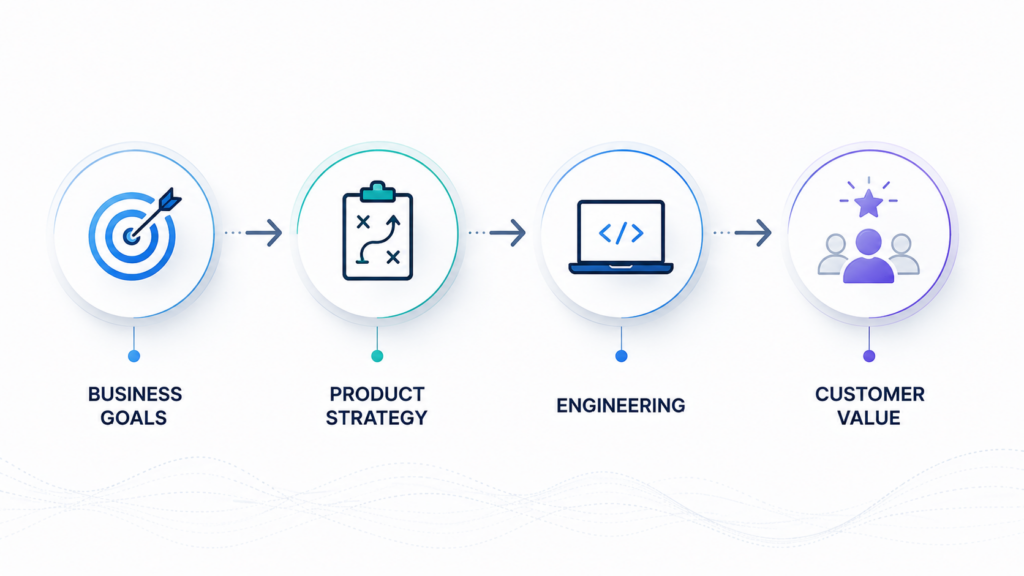
Technology organizations are becoming increasingly multidisciplinary. Engineering, product management, operations, cybersecurity, analytics, and executive leadership all contribute to decisions that shape digital products. When these groups operate with different priorities, organizations experience slower delivery, duplicated work, conflicting objectives, and higher operational costs. When they share common business goals, decision-making becomes significantly simpler.
Architecture supports product strategy. Engineering supports customer value. Technology supports business growth.
This alignment creates organizations that are not only more efficient but also more adaptable as markets continue to evolve.
Conclusion
Technology has never been more powerful, but technology alone has never guaranteed success.
Organizations that consistently achieve better outcomes understand that digital transformation begins with business objectives rather than technical implementation. Cloud platforms, artificial intelligence, modern architectures, and automation all create significant opportunities—but only when they support clearly defined goals.
In 2026, competitive advantage comes from aligning technology with strategy, engineering with customer value, and innovation with measurable business outcomes. Great technology creates lasting impact only when it solves the right business problems.
Why Ficus Technologies?
Ficus Technologies helps organizations bridge the gap between business strategy and technology execution.
Successful digital products require more than modern software development. They depend on thoughtful architecture, cloud-native engineering, AI integration, product thinking, and technical decisions aligned with long-term business goals.
By combining engineering expertise with strategic thinking, Ficus helps businesses build scalable digital platforms that create measurable value rather than simply adopting the latest technologies.
Most fail because of organizational challenges such as unclear business objectives, weak leadership alignment, and ineffective change management rather than technology itself.
It means ensuring technology investments directly support business priorities, customer needs, and measurable organizational outcomes.
Yes. Even technically successful projects may fail if they solve the wrong business problem or deliver little measurable value.
It helps engineering teams prioritize work more effectively, reduce unnecessary complexity, and focus on features that generate real business impact.
Because organizations increasingly measure success by customer outcomes and business value rather than the number of features delivered.





 Success...!